Davenant Bookstore
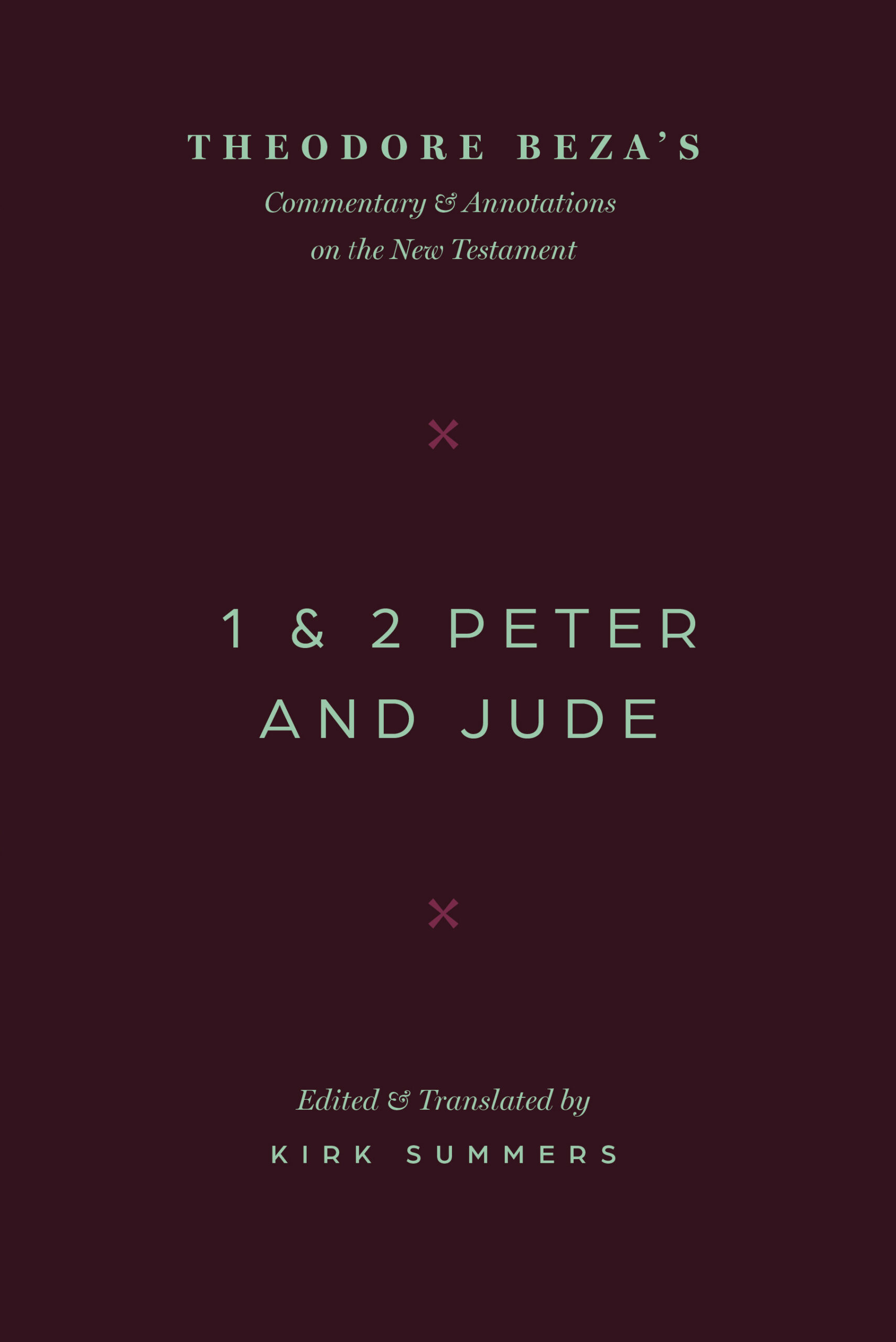
1 & 2 Peter and Jude (Theodore Beza’s Commentary & Annotations on the New Testament)
An Unrivaled Authority of 16th Century Biblical Exegesis
For centuries, Theodore Beza has been eclipsed by more famous Reformers such as John Calvin and Martin Luther. Yet, during the Reformation, his Annotations served as the benchmark for Reformed biblical commentary. Now, in a historic first, Davenant Press presents a contemporary English translation of Beza’s profound work on the Epistles of Peter and Jude.
Translated and edited by Professor Kirk Summers, this volume shows Beza as a devoted, prayerful, and brilliant student of the Word. Through exhaustive linguistic analysis and rigorous textual criticism, Beza brings a wealth of clarity to the Greek text, providing a transformative commentary useful for both pastors and scholars. This translation is more than a scholarly achievement; it is a powerful resource for the church. Readers will meet a pastor’s heart for believers enduring affliction and churches threatened by false teachers, as Beza takes up some of the most debated passages in the New Testament: Christ’s preaching to “the spirits in prison,” the authenticity of Second Peter, and Jude’s appeal to Enoch and the archangel Michael.
Continuing a landmark series from Davenant Press, Beza’s annotations on Peter and Jude invite a new generation to recover the legacy of a master and view the New Testament through the eyes of a Reformation giant.
Hardcover:
$57.95 $39.95
Paperback:
$39.95 $27.95
Limited-time launch price!
Available for purchase beginning November 12, 2026
About the Author

Kirk Summers
Kirk Summers grew up in Gulfport, Mississippi, the son of a Reformed Pastor. He studied Greek and Latin as an undergraduate, attended Reformed Theological Seminary in Jackson, Mississippi, and earned an MA in Latin from the University of Nebraska and a PhD in Classical Philology from the University of Illinois. After teaching at Loyola University Chicago, he joined the faculty of the University of Alabama in Tuscaloosa, where he spent the remainder of his career teaching Classics. His research focuses on Theodore Beza and the development of the Reformed tradition. His publications include Morality After Calvin (Oxford University Press, 2016) and the co-edited volume Theodore Beza at 500 (Vandenhoeck & Ruprecht, 2020). He lives in Hoover, Alabama.
Publication Details
- Publisher: Davenant Press
- ISBN-13 (Hardcover): 979-8-952321-05-2
- ISBN-13 (Paperback): 979-8-952321-04-5
- Formats: Hardcover, Paperback
- Dimensions: 6 x 9 in.
- Publication Date: November 12, 2026
- Pages: 380
- Editor and Translator: Kirk Summers
Endorsements
-
“Sometimes stereotypes take on a life of their own. While there is inevitably at least some truth in most stereotypes, the fuller reality is long forgotten, and thus, misunderstanding distorts the truth. Theodore Beza sometimes appears a victim of such treatment: reduced to a stereotypical logician and systematizer who cares little for the details and nuances of scripture. Thankfully, this new set of commentaries by Beza allows us to see just how carefully he engaged scripture both at the exegetical and pastoral level.”
— Kelly M. Kapic, Honorary Chair of Theology and Culture at Covenant College
-
“Kirk Summers is to be congratulated on making Beza’s hugely influential Commentary and Annotations on the New Testament accessible to an English-speaking readership for the first time. This readable and clearly set out translation will be widely used for many years to come.”
— Anthony N. S. Lane, Professor of Historical Theology, London School of Theology
-
“Desiderius Erasmus’ famous edition of the Greek text was in fact a byproduct of his plan to present a new Latin translation of the New Testament. The added Annotations opened up the text for generations of students. Half a century later, Theodore Beza planned a really good Latin translation of the books of the New Testament and devoted great text critical and linguistic work to that cause. It took a lifetime to update and revise this great work of scholarship. It takes a mature scholar like Dr. Kirk Summers to bring Beza out of the shadow of John Calvin and present the Annotations to new generations of students. The professor of Classical languages sets a format of translation which is much needed in all parts of the world where the classical languages lost space in educational programs. After all, Beza’s intended readership were colleagues and students in the Reformed academies of his days.”
— Erik de Boer, Professor Emeritus of Church History, Theological University Utrecht (formerly Kampen), the Netherlands
-
“Busy pastors tend to work downstream from primary sources like Beza but for pastors willing to wade into Beza’s work, rewards await! Kirk Summers not only provides a readable translation but is an insightful guide, carefully situating Beza’s project in its 16th century context.”
— Casey Shutt, Pastor of King’s Cross Church (PCA), Oklahoma City
More Endorsements (9)
-
“Without doubt this publication is a historical milestone. Not only is it the first English translation of Beza’s valuable comments on the Petrine epistles and Jude, but also the start of a series of edited translations of this so influential and so underestimated theologian. Beza was not just the successor of Calvin, not the rationalistic scholastic but a diligent, pious student and teacher of Scripture. Kirk Summers deserves praise for this wonderful edition and Davenant for this great initiative.”
— Herman Selderhuis, Professor of Church History, Theological University Apeldoorn, President of Reformation Research Consortium (REFORC)
-
“Heirs of the Protestant legacy ‘stand on the shoulders of giants.’ In this work, Kirk Summers introduces us to one of those mighty men of the Reformation, Theodore Beza. This introduction comes not by way of biography but by access to Beza’s genius and gift to the church that is his Commentary and Annotations on the New Testament. Summers’ excellent introductory material helps orient the reader to the translated work. While I do not doubt that this volume (and its companions) will benefit scholarship, I am confident that it will be a boon to the church. For here we can carefully study Scripture with Theodore Beza, a man of devotion and erudition. Pastors and preachers of the Word will find a treasury of insight into the sacred text. I found this volume on the Petrine epistles and Jude interesting and helpful. I think you will, too.”
— Jeremiah Bradford, Pastor of Cornerstone Baptist Church
-
“The beauty of this volume lies in the editor-translator’s careful mediation between early modern scholarship and 21st-century readers. By combining clarity with intellectual rigor, the translation makes accessible a foundational yet often neglected side of Reformation biblical scholarship. This book helps us see Beza’s reverent commitment to the language of the Holy Spirit in clearer view.”
— Sam Ha, Curator of the Meeter Center for Calvin Studies
-
"It is an excellent initiative by Davenant Press to make Theodore Beza’s commentaries on the New Testament available in English for the first time. These writings clearly show Beza’s mastery of Greek, his meticulous precision, and the deep spirituality from which he translated. As a result, this commentary offers not only historical insight but also a contemporary biblical-theological contribution to understanding the meaning of God’s Word. Highly recommended.”
— Willem van Vlastuin, Chair for Theology and Spirituality of Reformed Protestantism, Free University of Amsterdam
-
“Professor Summers claims that Beza’s Herculean efforts to produce a new translation of the Latin Bible, along with notes, represented the meticulous work of one of the foremost Latin and Greek scholars of the Reformation. Likewise, Summers has labored long and hard to present us with an excellent English translation of Beza’s work on the Books of 1 & 2 Peter and Jude. I, for one, am grateful for this outstanding contribution and am looking forward to more.”
— Martin I. Klauber, Affiliate Professor of Church History at Trinity Evangelical Divinity School and Scholar-in-Residence at Puritan Reformed Theological Seminary
-
“The publication of Theodore Beza’s Commentary and Annotations on the New Testament is another encouraging sign of theological recovery in this generation. The interest in returning once again to look at some of the most foundational documents of the Reformation and to understand the direct relevance of these writings to the church and to Christian responsibility today is an encouraging development and should be welcomed by all Christians. I am deeply thankful for this volume on Peter’s epistles and Jude, and I encourage all those who love the Word of God to pay heed.”
— R. Albert Mohler, Jr., President, The Southern Baptist Theological Seminary
-
“Theodore Beza’s contributions as a textual critic, commentator, and theologian are too often neglected. What a gift, then, for Kirk Summers to give us a translation of Beza’s annotations and commentary on the epistles of Peter and Jude. In this day of theological retrieval, we must not forget to retrieve the contribution of those who played such a formative role in the reformation of the church. In this commentary we see Beza’s skills as a philologist, commentator, and theologian. Pastors and scholars will both benefit from this work.”
— Thomas R. Schreiner, James Buchanan Harrison Professor of New Testament Interpretation, Associate Dean, The Southern Baptist Theological Seminary
-
“Kirk Summers provides an invaluable service to a wide range of readers by translating and editing Theodore Beza’s Commentary and Annotations on the New Testament. A brilliant humanist, Beza translated the New Testament into Latin, offering explanations when his translation differed from previous ones, most notably the Vulgate. Summers quite deftly translates into English both Scripture and the reformer’s annotations. This second volume, on the Petrine epistles and Jude, includes an excellent introduction to this ambitious project. We will all be anxiously awaiting the next publications in this multi-volume series.”
— Jeffery R. Watt, Kelly Gene Cook Sr. Professor of History, University of Mississippi
-
“Theodore Beza’s Latin Annotations on the New Testament was the gold standard of reformed Protestant biblical scholarship in the sixteenth century. And yet, surprisingly, Beza’s work as an exegete has received little scholarly attention over the centuries. In this erudite volume, Kirk Summers offers readers a superb English translation (with judicious footnotes) of Beza’s annotations on the epistles of Peter and Jude which displays why the reformer’s philological and theological judgments were so prized (and so debated) by his contemporaries.”
— Scott Manetsch, Chair of the Church History and the History of Christian Thought Department, Professor of Church History, Trinity Evangelical Divinity School
From the Book
“The introduction to the first volume of this series, which covered the Epistle of James, presents a detailed description of Beza’s project to translate and annotate the New Testament, including the goals he set for himself, the methodology employed, and the tools and sources at his disposal. The highlights of that story merit a retelling in the current volume, but a new volume also offers an opportunity to expand upon it with new theological and philological dimensions. In the original introduction, the prefaces of the various major editions supplied the bulk of the material for reconstructing how these translations and annotations assumed their form, while Beza’s extensive correspondence provided additional context. But much more waits to be said. The minor editions, with their greatly abridged notes and removal of the Vulgate text, feature a different preface, extolling, according to the title page of the 1565 octavo edition, “the authority of the written Word and the true interpretation of it.” This description promises something less technical than what is found in the major editions yet more pertinent to the target audience of the smaller volume. Here, Beza exhorts his readers in urgent and impassioned tones to stay the course of reform and to shake free from a lifeless and ossified ecclesia in favor of one reconstituted and revitalized, now submitted wholly and faithfully to the Word of God.
The two prefaces reflect Beza’s vision for his New Testament scholarship from two vantage points. The prefaces of the major annotations speak to the academic requirements underlying the effort to produce a faithful representation of the Scriptures, while the preface of the minor annotations calls readers to align their minds and lives wholly with the revelation received from the prophets and apostles. The philological precision heralded in the greater folio volumes merges seamlessly with the primacy of the Word exalted in the abridged octavo ones. When considered side by side, a fuller, more complete picture of Beza’s work and aims comes into focus.
We begin, therefore, with a review of the prefaces to the major annotations, supplemented with substantive new information gleaned from the work on the letters of Peter and Jude, and follow with a summary of the argument presented in the prefaces to the minor editions of the annotations from 1565 onward. Juxtaposed in this way, the two prefaces present a coherent message: the deep conviction that God has revealed His character, expectations, and activity to His creation through the Holy Spirit by means of the Word. Faith, salvation, holiness, and reverence all find their surest—and indeed only—foundation in that Word; apart from it, humanity cannot be restored to wholeness. What, then, could be more fundamental to the health of the Church than possession of an accurate form of God’s revelation, both in text and translation? The Word is the starting point of everything the Church does.
Beza expresses this conviction beautifully and succinctly in his defense of ecclesiastical discipline in the churches in the 1590 treatise on the Consistory, an institution of oversight he regarded as one of the marks of the true Church. There he reminds the reader that even the Church’s moral court must concede ultimate power for the transformation of behavior to the Spirit working through the Word:
“Lastly, it cannot be denied, except wrongly, that external civil punishments achieve nothing—unless the Spirit of God is added—other than causing people to abstain from sins, at least somewhat, from fear of punishment; and, as a consequence, the threat of punishment does not cut the roots of sin, but only the branches, which will sprout again. This is because the power of the Holy Spirit alone can cut the roots, working through the Word of God, when it is preached both publicly and privately, and as it penetrates even to the division of soul and spirit.”
The Church’s influence over wayward members or those in open rebellion can only go so far in restraining and correcting behavior. By itself, the Church cannot change hearts or save souls; it cannot penetrate deeply enough to effect true spiritual transformation. That work belongs to the Word of God alone as it takes root in its hearers through the power of the Holy Spirit. Above all, this conviction formed the spiritual and intellectual framework within which Beza carried out his textual work on the New Testament.”
From the Introduction by Kirk Summers
Table of Contents
- Praise for this volume
- Acknowledgements
- Abbreviations
- Introduction
- 1 Peter Chapter One
- 1 Peter Chapter Two
- 1 Peter Chapter Three
- 1 Peter Chapter Four
- 1 Peter Chapter Five
- 2 Peter Chapter One
- 2 Peter Chapter Two
- 2 Peter Chapter Three
- Jude Chapter One
- Appendix One
- Appendix Two
- Bibliography