Davenant Bookstore
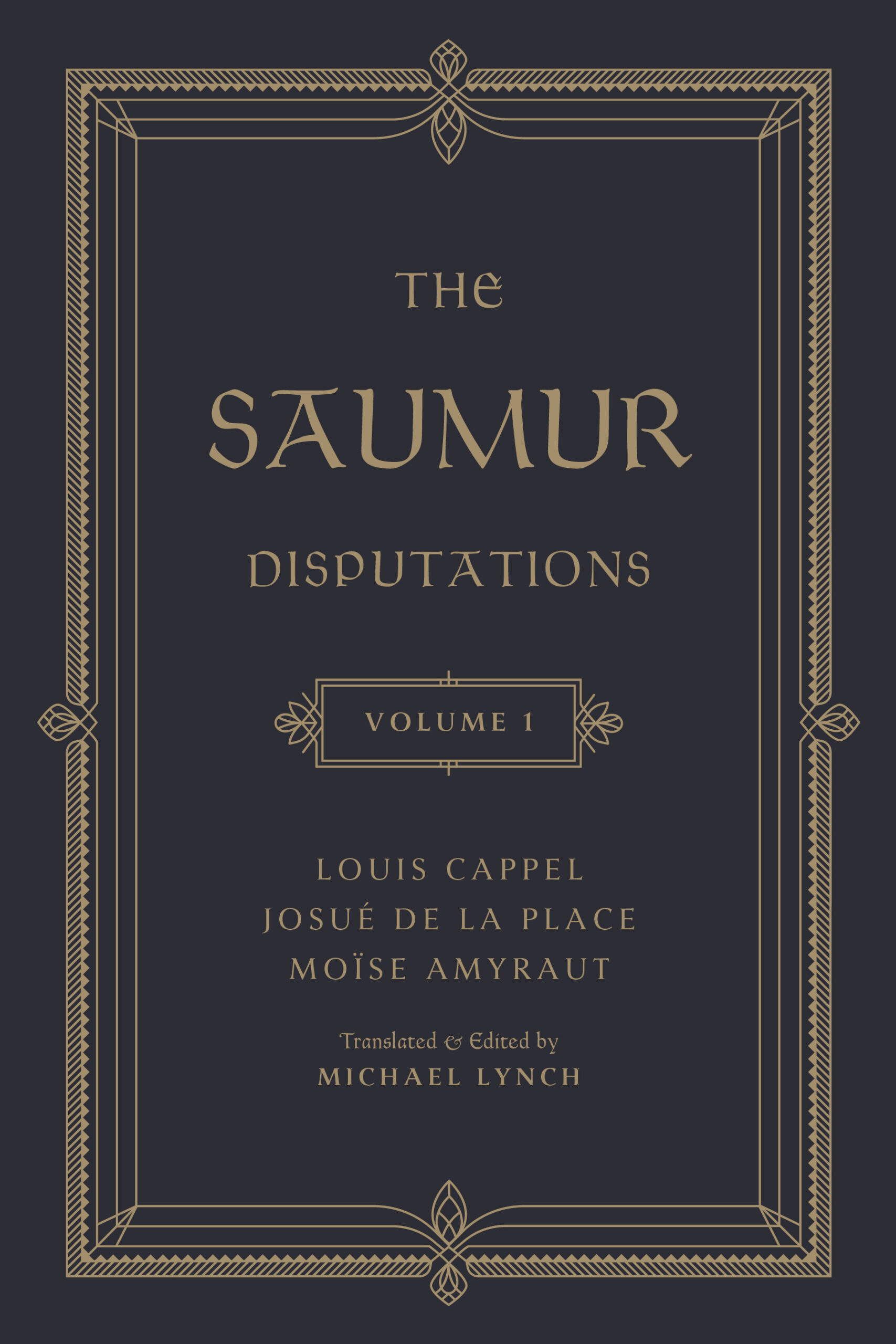
The Saumur Disputations, Vol. 1
Seventeenth-century French Reformed theology at its sharpest, now in English
For generations, English-speaking readers have known the Academy of Saumur mostly through secondhand summaries, usually filtered through the controversy over Moïse Amyraut and universal grace. This first volume of The Saumur Disputations changes that, letting Saumur’s celebrated “triumvirate” of Louis Cappel, Josué de la Place, and Amyraut speak in English for the first time.
Founded around 1600 under the protection of the Edict of Nantes, Saumur became one of the leading Protestant academies of the later Reformation. Shaped by the Scottish theologian John Cameron, its faculty trained France’s Reformed pastors for more than thirty years. Like other Protestant schools, Saumur worked through the loci of theology in a cycle of public disputations, with students defending theses written by their professors. The nine disputations gathered here were defended and published in the mid-1630s. Together they offer a sustained doctrine of Holy Scripture, aimed squarely at the claims of Roman Catholic theology.
The disputations in this volume cover the origin and necessity of Scripture, its authority, the canon, the translation of the Bible, Scripture’s perfection and perspicuity, and the question of who is the supreme judge of controversies. The volume closes with a two-part treatment of the inward testimony by which the Holy Spirit seals the divinity of the Scriptures in believers’ minds. The result is a Reformed doctrine of Scripture that is rigorous, deeply exegetical, and fully conversant with the tradition.
Michael Lynch translates from the 1664–65 second edition of the Saumur theses. His rendering is careful yet readable, untangling Amyraut’s famously long sentences without losing the precision of the argument. A concise introduction sets the historical and theological scene, and a Scripture index makes the volume a ready reference.
Saumur is about far more than a disputed view of predestination. This volume belongs on the shelf of every student of Reformed orthodoxy, French Protestantism, and the doctrine of Scripture.
Hardcover:
$56.95 $38.95
Paperback:
38.95 29.95
Limited-time launch price!
Available for purchase beginning November 12, 2026
About the Author

Michael Lynch
Dr. Michael J. Lynch (PhD. Calvin Seminary) teaches Classical Languages and Humanities at Delaware Valley Classical School in New Castle, DE. He is also a teaching fellow at the Davenant Institute. He is the author of John Davenant’s Hypothetical Universalism: A Defense of Catholic and Reformed Orthodoxy (Oxford University Press, 2021).
Publication Details
- Publisher: Davenant Press
- ISBN-13 (Hardcover): 979-8-952321-03-8
- ISBN-13 (Paperback): 979-8-952321-01-4
- Formats: Hardcover, Paperback
- Dimensions: 6 x 9 in.
- Publication Date: November 12, 2026
- Pages: 288
- Editor and Translator: Michael Lynch
Endorsements
-
“Saumur is so much more than a disputed view on predestination and this volume demonstrates that clearly. The fine translation and edition that Dr. Lynch presents helps us to get more out of the rich sources of early modern reformed academic theology. And The Davenant Institute deserves praise for the courageous enterprise to make The Saumur Disputations much more accessible.”
— Herman Selderhuis, Professor of Church History and Church Polity, Theological University Apeldoorn
-
One does not need to agree with everything from the “Cameronian triumvirate”—Louis Cappel, Josué de la Place, and Moïse Amyraut—to strongly value this new translation of the Saumur Disputations. For far too long most readers have been dependent on brief textbook descriptions of their views, whether those assessments praised or condemned them. But now all English speakers can wrestle with the primary texts themselves. I would encourage readers to pick up a copy of both the Synopsis of a Purer Theology (representing a form of high 17th-century Reformed orthodoxy) and these Saumur Disputations (representing an innovative and controversial form of the Reformed tradition). Read both sets of disputations alongside one another to better understand the nuances behind the different perspectives as well as to encourage you to discover all the areas of fundamental agreement. I can promise that going through such a rigorous exercise will prove both stimulating and informative.”
— Kelly M. Kapic, James and Martha Seneff Chair of Theology and Culture, Covenant College
-
“Michael Lynch’s translation of the Saumur Disputations is a highly welcome addition to the literature of the French Reformation. It skillfully illuminates key theological debates, including the proper relationship between Scripture and the Church, as well as the self-authenticating divine nature of biblical revelation. Ultimately, this volume showcases the profound depth and richness of seventeenth-century French Reformed theology.”
— Martin I. Klauber, Affiliate Professor of Church History at Trinity Evangelical Divinity School, and Scholar in Residence at Puritan Reformed Theological Seminary
-
“Dr. Lynch’s translation of The Saumur Disputations demonstrates that French Calvinism during the era of the Edict of Nantes (1598) should not be reduced to the debate about hypothetical universalism and the extent of the atonement. Here we find theologians Louis Cappel, Moïse Amyraut, Josue de la Place engaging in pivotal issues surrounding Holy Scripture in the Protestant debate with Roman Catholicism. In our day when the treasures of classic Protestant theology need to be reasserted vis-a-vis the allurements of modernized Roman Catholicism, this work is not only welcomed, but highly recommended. It reveals with clarity why the Protestant and Reformed traditions have well understood what Luther meant when he declared, 'Here I stand. My conscience is bound by the Word of God.'”
— Dr. Peter A. Lillback, President Emeritus, Westminster Theological Seminary, Philadelphia
More Endorsements (5)
-
What a gift this volume (and the ones to come) is for students and scholars of the French Reformed tradition. The school at Saumur played a vital, albeit controversial, role in the development of Huguenot theology and culture. And these volumes make available for those who have little knowledge of Latin deeper insight into the thinking of the Saumur theologians. Kudos to both Michael Lynch and to Davenant Press for bringing these translated works to print.”
— Michael A.G. Azad Haykin, Professor of Church History, The Southern Baptist Theological Seminary, Louisville, KY
-
“Michael Lynch’s translations of the voluminous Saumur Disputations take readers on a fascinating journey through the cycle of theological loci taught at one of the leading Protestant universities of the later Reformation. The theses, authored by the academy’s theologians—Louis Cappel, Josué de la Place, and Moïse Amyraut—present a distinctive expression of Reformed theology, standing firmly against the Romanists, while also articulating positions that would become the focus of important debates within the Reformed tradition. Lynch’s masterful translations capture the careful, scholarly tone of the disputations while remaining consistently readable and clear.”
— Kirk Summers, Professor of Classics (Emeritus), The University of Alabama
-
“The welcome publication of these disputations for the first time in English provides a comprehensive account of the theology taught at the Academy of Saumur under the visionary leadership of Louis Cappel, Josué de la Place, and Moïse Amyraut. Through this series of texts, brought superbly to life in the translation of Michael Lynch, the reader can almost hear the voices of these venerable scholars echo down the years, and imagine the rigour, vigour, and intensity of study in the Academy, as it sought in community to bring to human expression the truths of God’s Word. The result is a dynamic and illuminating account of Reformed theology that is both deeply immersed in Scripture and fully conversant with tradition. If on occasion it be rather provocative, yet it is always worth careful reading.”
— Paul T. Nimmo, King’s Chair of Systematic Theology, University of Aberdeen
-
“For too long the Saumur theology has been misunderstood or neglected. This fine edition and translation by Michael Lynch promises to change that and introduce the theology of Moise Amyraut, Josué de la Place and Louis Cappel to an English-speaking audience. This will undoubtedly be valued by all students of Reformed scholasticism and speak into current debates on the intellectual landscape of Reformed theology.”
— Simon Burton, John Laing Senior Lecturer in Reformation History at the School of Divinity, University of Edinburgh
-
“The Davenant Press published in 2023 the Synopsis of a Purer Theology from the 17th century University of Leiden, in the Netherlands. Now, the same publisher provides the public with another important set of post-Dordrecht Protestant theological theses, The Saumur Disputations, this time from the 17th century Academy of Saumur in France. The six-volume publication of The Saumur Disputations should be welcomed by all, even by those of Reformed convictions who do not share the theological features that distinguish the Academy of Saumur: first, because the Disputations will be a reliable source to ground an informed disagreement, and, second, the many points of agreement with the Disputations will offer an occasion to rejoice in the ecumenical spirit of Reformed catholicity.”
— Marco Barone, Ph.D., Queen’s University Belfast, independent scholar and author of Luther’s Augustinian Theology of the Cross
From the Book
“DISPUTATION EIGHT
On the Testimony by which the Holy Spirit Seals the Divinity of the Scriptures in the Minds of Men, Part One
Presided over by Dr. Moïse Amyraut, with Peter Sylvius of Amsterdam in Holland responding.
I. Although in our disputation concerning the authority of Holy Scripture we have already discussed those points which are sufficient to undermine the position of the teachers of the Roman Church, and to settle every disagreement between them and us on that topic; and although some points have been disputed in our theses on the Canon, translations, perfection, and perspicuity of the Scriptures, and especially concerning the judge of controversies, which depend upon the authority ascribed to God’s Word, nevertheless, since human error has made this question extremely difficult and complex in our age, and given that there is a lot of heated debate on both sides about the testimony of the Spirit, it seems worthwhile for us to carefully investigate and precisely explain, as far as we are able, the Holy Spirit’s role in this matter.
II. Even the fairest and most accurate papal teachers concede to us that the Holy Scriptures are divine and that all the books comprised in their Canon equally have God as their author, [and concede that such knowledge] is based on a twofold testimony of the Holy Spirit: one is external and public, the other internal and private, regardless of what others may loudly object to or misrepresent about such an internal testimony of the Spirit. [Thomas] Stapleton, a most forceful and sharp debater on this topic, says in his book on the authority of the Word of God against [William] Whitaker (ch. 1): “This secret testimony is absolutely necessary for someone to believe the Church’s testimony and judgment about its approbation of the Scriptures. Without this internal testimony of the divine Spirit, even if the Church were to attest to, commend, promulgate, and endorse the Scriptures a thousand times, those hearing would neither believe, nor be persuaded.” But the entire dispute hinges on explaining the nature of each of these [two] testimonies.
III. Now, as far as public testimony is concerned, orthodox theologians believe that no external testimony is of greater or more unquestionable authority than that of the Holy Spirit speaking in Scripture in such a way that it everywhere bears certain, undeniable marks of its heavenly origin. Unless people recognize these, they must be clearly blind. God could not speak without his voice having some [characteristics] to distinguish it from all other voices. Moreover, the arguments Scripture uses to demonstrate its own divinity can be called the testimony of the Spirit of God, because they produce such firmness of assent as would be produced by God’s own voice were he to testify from heaven about Holy Scripture like he once did about his most beloved Son. And rightly so. For, since people could and indeed should have concluded with absolute certainty by reasoning from the wonderful works which Christ performed on earth that he was the true and genuine Messiah promised by the prophets, therefore he says (John 10:25), “the works I do in my Father’s name testify about me.”
IV. Our opponents maintain that all Christians certainly acknowledge that Scripture is divine. But they claim that the only argument by which Christians are firmly convinced of this is that the Church confirms it by its testimony. Moreover, they say that the Church’s testimony is called the testimony of the Spirit because the Church speaks by the prompting of the Holy Spirit, who is perpetually present to it, so that it can never be deceived or deceive others in giving that testimony, or in anything else related to faith and religion. Therefore, [they maintain that] Christians do indeed regard Scripture as divine, for otherwise they would be doomed. Yet, [they say that] this truth is not clear and evident to them in any other way except that the Spirit, speaking as it were through the Church’s mouth, announces it to everyone.
V. In deciding this question, we do not want to be too wordy. For, in our theses on the authority of Scripture, along with certain other points, we established these two points especially along with what we consider necessary evidence and reasoning: [First,] that Scripture’s divine nature cannot be known with certainty and indubitably from any source other than Scripture itself, not even from the Church’s testimony; likewise, [secondly,] that Scripture itself can prove with absolute certainty that it was divinely given to humans. These points undoubtedly attacked the very citadel of their argument. There are, however, a few points relevant to our purpose which we think should be added to or repeated from the previous disputation.
VI. And, indeed, the first point is that even if it were true that the Church (whatever finally it may be) provides an indubitable testimony about [Scripture’s divinity], it still would not follow that Christians are convinced by this single argument alone that Scripture is divine. After all, there can be many equally certain reasons and undeniable arguments for one and the same thing. Sometimes geometric propositions are proven in several ways with the same level of evidence and necessity. There could not be any more certain testimony than when that heavenly voice says [Matt. 3:17], “This is my beloved Son….” For God himself is said to have spoken, and there is no doubt that this should have had the greatest impact on people’s minds in embracing Christ as God’s true Son. And yet, Christ often appeals to the Old Testament Scriptures, and says [John 5:39], “It is they that bear witness about me.” And Christ himself, by his incomparable holiness of life, the divinity of his doctrine, and finally the very miraculousness of the works which he performed, was able not only to draw people to faith, but actually did so. Therefore, if Scripture indubitably proves itself to be divine by clear arguments, why will it not obtain from us belief and assent on its own as much as by the Church’s testimony?”
From Disputation 8, sections I–VI (presided over by Moïse Amyraut)
Table of Contents
- Acknowledgements
- Introduction
- Disputation 1: On the Origin and Necessity of Scripture (Presided Over by Dr. Louis Cappel)
- Disputation 2: On the Authority of Holy Scripture (Presided Over by Dr. Moïse Amyraut)
- Disputation 3: On the Canon (Presided Over by Dr. Josué de la Place)
- Disputation 4: On the Translation of the Holy Bible (Presided Over by Dr. Louis Cappel)
- Disputation 5: On the Perfection of Holy Scripture (Presided Over by Dr. Moïse Amyraut)
- Disputation 6: On the Perspicuity of Scripture (Presided Over by Dr. Josué de la Place)
- Disputation 7: On the Supreme Judge of Controversies (Presided Over by Dr. Louis Cappel)
- Disputation 8: On the Testimony by which the Holy Spirit Seals the Divinity of the Scriptures in the Minds of Men, Pt. 1 (Presided Over by Dr. Moïse Amyraut)
- Disputation 9: On the Testimony by which the Holy Spirit Seals the Divinity of the Scriptures in the Minds of Men, Pt. 2 (Presided Over by Dr. Moïse Amyraut)
- Scripture Index