
This post is a preview of a forthcoming online Davenant Hall class, “Luke/Acts: The Gospel and the Church”, running in the Fall 2021 Term (September – December), and convened by Dr. Matthew Colvin.
If you wish to register for the module, you can do so here.
Why study Luke-Acts?
Luke penned more of the NT than any other author. He’s also the evangelist who covers the greatest sweep of history, giving us details on Jesus’ conception and birth, and tracing the ministry of Paul up to its denouement in Rome. The gospel of Luke represents the final synthesis of the synoptic tradition with treasured material not found in Matthew or Mark, such as the parables of the Good Samaritan, the Rich Man and Lazarus, and the Prodigal Son; or the stories of Mary and Martha, the calling of Zacchaeus, and the raising of the widow’s son at Nain.
In the Fall 2021 Davenant Hall course “Luke/Acts: The Gospel and the Church” course, we will propose that Luke’s programme can be best understood as underwritten by another of Luke’s unique stories: the appearance of Jesus to the disciples on the way to Emmaus, as Jesus “beginning with Moses and all the Prophets, interpreted to them in all the Scriptures the things concerning himself” (Luke 24:27). The details of Luke’s diction and phrasing are deeply grounded in the Old Testament, and we will revert again and again to the text of the Septuagint to discover new echoes of Scripture in Luke’s narratives, which in turn will cast the events of Jesus and the apostles in a new light. Typology has its reality through the providence of the God who orchestrated all the events of Israel’s history, and caused them to be reported to us through the eyes of Jews who were steeped in the Scriptures. Luke’s writings simply cannot be understood without a similar immersion in the Old Testament. We must attune our ears to hear the echoes.
Our hermeneutical approach to the text of Luke and Acts will therefore refuse to divide between theology and history, believing instead that “these things were not done in a corner” (Acts 26:26): Luke wrote an “orderly account” of “things that were accomplished” and attested by eyewitnesses, so that we might “have certainty” (Luke 1:1). Among the eyewitnesses are Mary, Jesus’ mother, who provides Luke with details of Christ’s conception and birth; and Luke himself, who switches into the first person plural in Acts 16:10 to indicate his involvement in the events he narrates. The historicity of the text is also corroborated by comparison with documents from the Roman world: the routes of Paul’s sea voyages, the names of Imperial procurators and Herodian royalty, descriptions of etiquette and protocol (“[Festus] took his seat on the bema”), and even details of physical objects (“a ship of Alexandria, with the twin gods as a figurehead”) all evince the accuracy of Luke’s account.
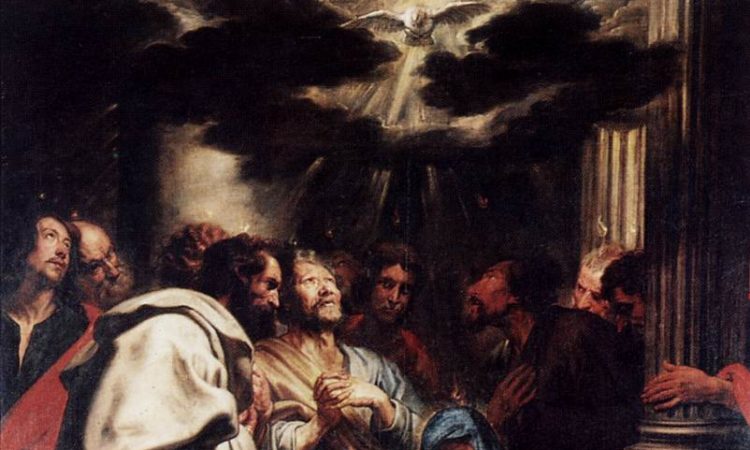
At the same time, Luke clearly tells us that the same God who filled the Temple of Solomon and the Tabernacle of Moses has come “with the sound of a mighty rushing wind” and “filled the whole house” where the Jerusalem church was at Pentecost. Not only does this mean that God acts in history, but it also means that Luke is making the strongest of theological claims, for no Jew could have read the Pentecost account in Acts 2 without drawing the conclusions that (1) the Holy Spirit is the God of Israel who filled the Tabernacle and Temple in the same manner, and (2) the Church is the new Temple, the locus of God’s presence in the world. On every page, we will find clear signs that Luke considers Jesus to be “both Lord and Christ,” and that the behavior of the earliest Christians was thoroughly shaped by a theology that accords divine worship to Jesus and the Spirit. Both Luke and Acts give us the highest christology and pneumatology.
More than any other NT author, Luke reproduces speeches as Jesus and the apostles are led before councils, governors, and kings. Over and over again, the tables are turned and the verdict is passed upon the authorities who presume to try Jesus and His servants. In all these scenes, the reader is confronted with the question: “Who do you say that I am?” (Luke 9:20) We will pay special attention to two things when analyzing the forensic speeches in Acts: first, the way they position Christians in connection to Israel’s covenant and story; second, their rhetorical stance toward the authorities whom they address.
In this connection, it is significant that Acts is our main NT source for the encounter between the Gospel and Greco-Roman culture, whether it be Paul quoting Stoic philosophers and Aratus of Sicyon on the Areopagus, or a Roman tribune being astonished that Paul could speak Greek. Acts thus offers us models for how Christians ought to handle pagan philosophy and culture, but these models are not as straightforward as “plunder the Egyptians” or “Jesus is Lord, so Caesar is not.” Paul is subtle in his use of Greek terminology: “In him we live and move and have our being” is a sort of bait-and-switch: the line is from the 6th century BC Cretan poet Epimenides. A Stoic on the Areopagus would of course hear pantheism in these words — “we will hear you again on these matters,” Luke has them respond — but Paul is using them to point to the sort of ubiquitous presence of God within the creation that is spoken of in Psalm 139:
“Where can I go from Your Spirit?
Or where can I flee from Your presence?
If I ascend into heaven, You are there;
If I make my bed in hell, behold, You are there…”
A Stoic would be interested, all right, but if he persevered in learning about the Christian faith, he would eventually discover that Paul was teaching something very different from pantheism. He was teaching the story of Israel, and indeed the triumph of Israel’s God: “These times of ignorance God overlooked, but now he commands all men everywhere to repent. He has set a day when he will judge the oikoumene — the inhabited Roman world — with justice by the Man whom He has appointed. He has given proof of this to all men by raising Him from the dead.” (17:31) With these words, Luke’s Paul ties in to the Jewish expectation of eschatological monotheism, expressed, e.g., in the latter chapters of Isaiah, that someday all nations would know and worship Israel’s God.
For a further taste of the approach we will take in this course, you can watch this short video below for an exposition of Luke 7:11-17, in which we find the story of the raising of the widow’s son at Nain – a story unique to Luke.
This Biblical Theology course will be taught by Dr. Matthew Colvin. This course will run from September 10th through December 12th. The syllabus can be viewed here. Register here.
Dr. Matthew Colvin is a presbyter in the Reformed Episcopal Church. From 2012-2017, he served as a missionary teaching ministerial students in the Philippines and Indonesia. He holds a PhD in ancient Greek literature from Cornell University (2004). His published works include articles on Heraclitus (Oxford Studies in Ancient Philosophy 2005 and The Classical Quarterly 2006), a translation from Latin of the 1550 Magdeburg Confession (2011), and The Lost Supper, a study of the Passover and Eucharistic origins (Fortress Academic, 2019). He is currently working on a book on women’s ordination and the origins of ordained office in the early church. He lives on Vancouver Island.