Davenant Bookstore
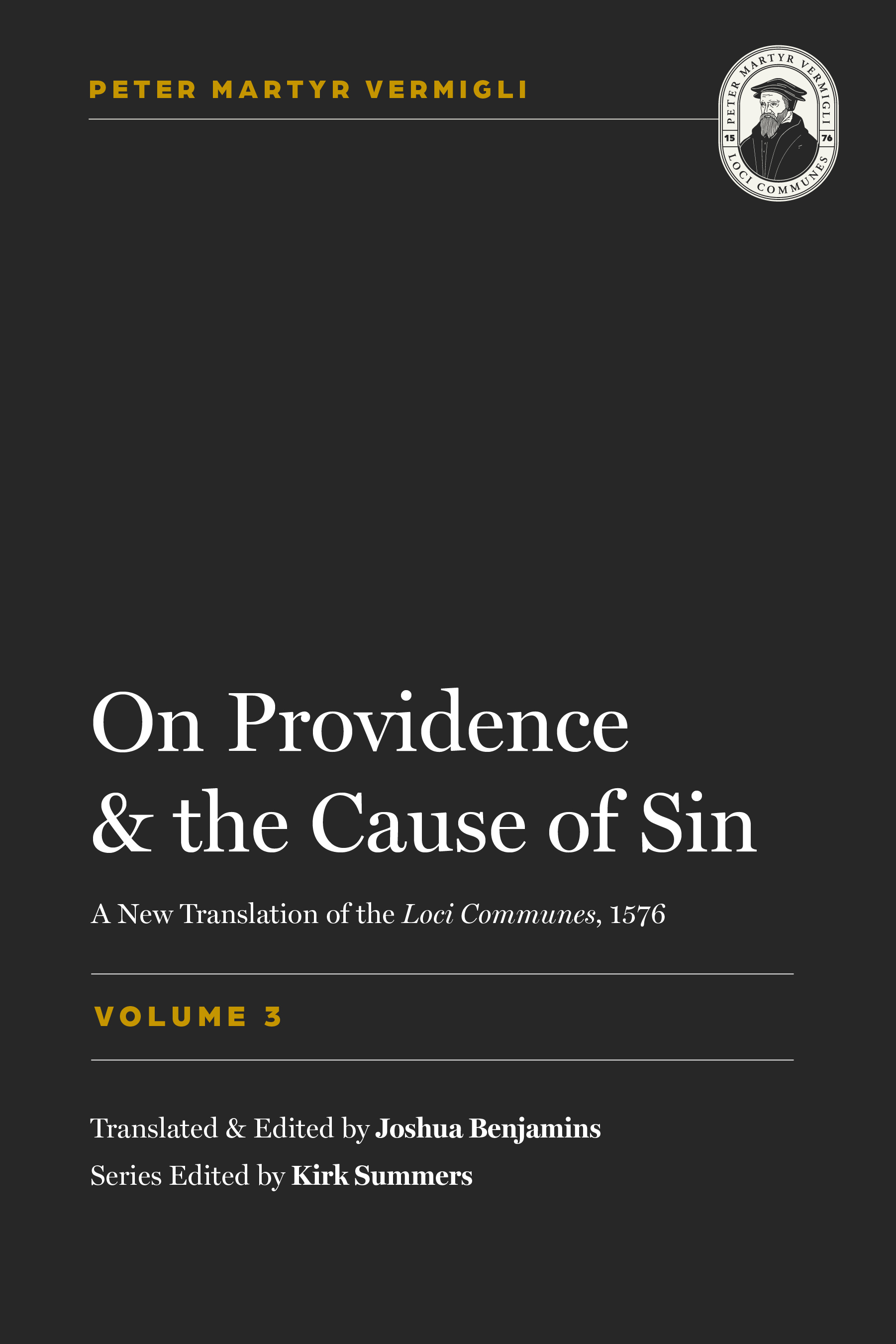
On Providence & the Cause of Sin
Vermigli’s Common Places, Vol. 3
God directs and orders all things.
Peter Martyr Vermigli (1499-1562) was a forgotten giant of the Protestant Reformation. Born in Florence, Italy, and rising quickly to leadership within the Augustinian Order in Italy, Vermigli discovered the gospel of justification and embarked on a reforming career that would take him to Naples, Lucca, Zurich, Strasbourg, Oxford, and finally back to Strasbourg and Zurich again, as he worked shoulder-to-shoulder with other leading Protestant Reformers Heinrich Bullinger, Martin Bucer, and Thomas Cranmer. He left behind him voluminous biblical commentaries and treatises, and a band of faithful disciples who collected his writings into the massive theological compendium, the Loci Communes Appearing now in English for the first time since 1583, On Providence and the Cause of Sin is the next installment in Davenant Press’s ongoing translation of the Loci Communes of Peter Martyr Vermigli. Presented here in a clear, readable, and learned translation, we first have Vermigli’s treatment of the topic of providence, accompanied by related questions on God’s control over both the Fall and temptation to sin. With his characteristic rigor, Vermigli provides a masterful Reformed articulation of the relationship between necessity, contingency, and God’s sovereignty. With the Scriptures as his final authority, the Church Fathers as his guides, and philosophy as his handmaid, Vermigli produced Loci that withstand the rigors of time and remain a helpful guide to Protestants everywhere.
Publication Details
- Publisher: Davenant Press
- ISBN: 978-1-949716-55-9
- Publication Date: august 29, 2024
- Pages: 185
- Author: Peter Martyr Vermigli
Endorsements
-
“Benjamins contributes another volume to the important Loci Communes series by translating a section that treats one of theology’s thorniest conundrums: How do we square God’s absolute and active governance of the world with human freedom and personal responsibility? Or, as Sophocles would have put it (to give a nod to the humanism that Vermigli so embraced), can we blame Oedipus for murdering his father and marrying his mother when the gods foreordained it before his birth? Benjamins provides a learned introduction that situates Vermigli’s thought on the matter in the context of ancient philosophical and humanistic ideas on providence and fate along with their reception and adaptation in Medieval Scholasticism. In doing so, he details the complex web of influences behind Vermigli’s approach to the problem, identifying Aristotle and Augustine as two major sources for his choice of vocabulary and categories of thought. As for the text itself, Benjamins admirably translates with his reader always in view. He manages to avoid the stiff, archaic, Latinized English that could make a text like this impenetrable and instead offers a precise but eminently readable and modern version.”
— Kirk Summers, Professor of Classics, University of Alabama