Davenant Bookstore
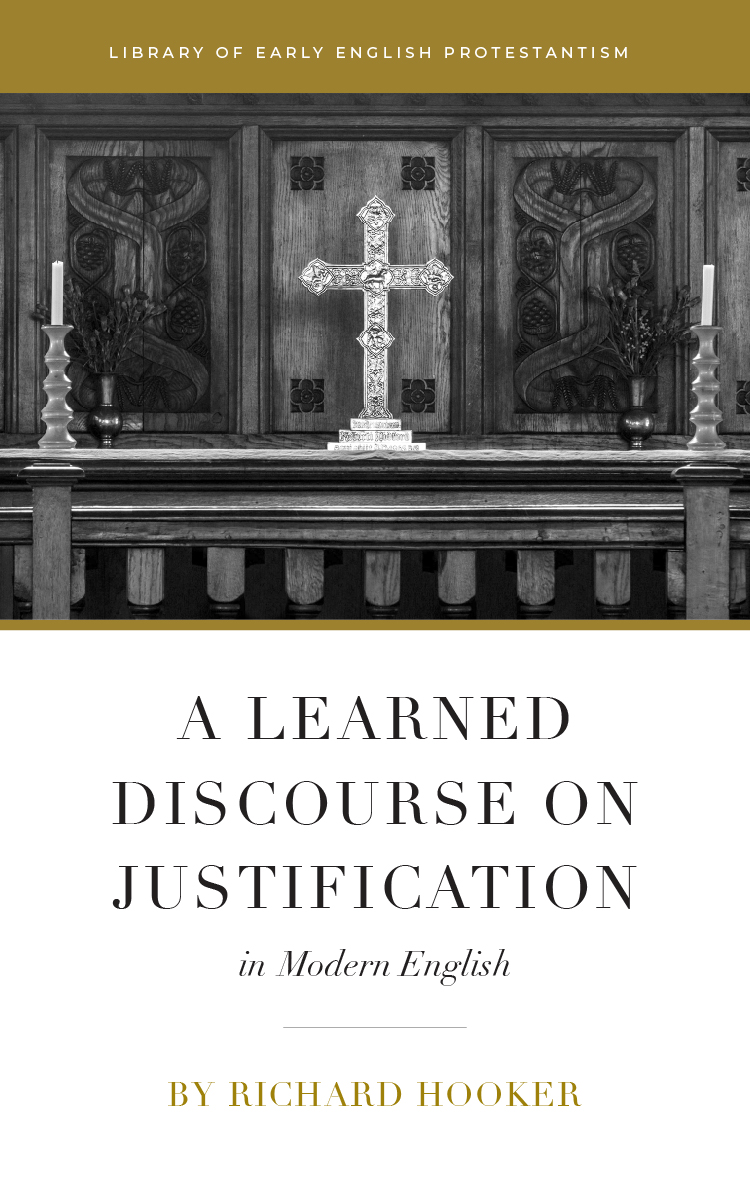
A Learned Discourse on Justification
In Modern English
The defining doctrine of Protestantism is justification by faith alone—what Martin Luther called “the article by which the church stands or falls.” But does this mean that it is also the article by which salvation stands or falls? Are Roman Catholics heretics for rejecting that doctrine?
In this classic treatise, the great English theologian Richard Hooker tackles this question head-on, seeking to head off two opposite errors: insisting so rigidly on a right articulation of the doctrine that we neglect Christ himself, or minimizing differences over justification as unimportant. In the process, Hooker also offers an excellent blueprint for how to interpret and navigate doctrinal disagreement within the church on any issue.
Centuries on, this remains one of the classic statements of Reformational soteriology, presenting a clear account of what Protestants do and do not believe about the doctrine of justification, along with a careful summary of what their Catholic opponents held. Readers seeking a helmsman who can faithfully guide them through the fog that so often bedevils this crucial conversation need no further.
Publication Details
- Publisher: Davenant Press
- ISBN: 978-1-949716-10-8
- Pages: 79
- Author: Richard Hooker
Endorsements
-
“Happy, secure Protestants recognize that we won’t do ourselves, or our spiritual progeny, long-term good by caricaturing Catholicism. There are problems, yes. Significant problems. The Reformation is not over. Good fences remain. And we will do better to love across such boundaries in the name of Jesus than to pretend they don’t matter. But there’s no virtue in distorting truth by exaggerating errors, or losing our capacity to give a holy benefit of the doubt. If we Protestants love the truth, and not just our tradition (ironically), we might give Hooker the hearing he deserves — and help keep young Protestants from future surprises.”
— David Mathis, Senior Teacher and Executive Editor at desiringGod.org Pastor at Cities Church (Saint Paul, MN) Author of “Habits of Grace”
-
“It is a tremendous service to the church to have this excellent modern edition of Richard Hooker’s bold and nuanced defense of the Reformed doctrine of justification by faith alone against the heresies and corruptions of Rome. As he beautifully puts it, Christ alone has satisfied and appeased God’s wrath, not our blood or our best works, and he is ‘the only garment which, once worn, covers the shame of our defiled natures, hides the imperfections of our works, and preserves us blameless in God’s sight.’ It is an immense joy to read this exposition from a great Anglican theologian.”
— Rev. Dr. Lee Gatiss, Director of Church Society and Editor of “The First Book of Homilies: The Church of England’s Official Sermons in Modern English”
-
“Brad Littlejohn and his associates have once again provided an accessible yet loyal version of a work of Richard Hooker that should still be known and valued, and that in a theological world wider than Anglicanism. In this extended and ‘learned’ sermon, Hooker shows that a clear loyalty to the Protestant principle of justification by faith does not necessarily deny salvation to those who erroneously deny the principle. We can and should carefully and accurately assert what we understand to be basic Christian theology and yet understand that those who disagree are not thereby cut off from the salvation that is the essence of the Christian Gospel. And we can delight in the learned rhetorical expression of this unity in diversity.”
— Rev. Canon W. David Neelands, Senior Teacher and Executive Editor at desiringGod.org Pastor at Cities Church (Saint Paul, MN) Author of “Habits of Grace”
-
“A Learned Discourse on Justification in Modern English is a treasure for the church. Hooker’s original work is supremely important. It further develops the question, ‘What is Anglican doctrine?’ For many, Hooker is the Theologian of Anglicanism. In this modern English version, the editors have made this 16th century work accessible and readable for the modern mind. Read this work and be anchored in the article by which the church stands or falls.”
— Bishop Julian Dobbs, Anglican Diocese of the Living Word (ACNA)
More Endorsements (2)
-
“As an evangelical theologian who teaches and writes on Roman Catholic theology and practice, I get many questions from evangelicals about their Catholic family members and friends: Are Catholics Christians? Isn’t Roman Catholicism a works-based religion? If Roman Catholicism has an improper understanding of the doctrine of justification—’not only the remission of sins but also the sanctification and renewal of the interior person’—can Catholics be justified, declared not guilty but righteous instead? This new, highly readable production of Richard Hooker’s book on justification helps us answer those questions in ways that may be surprising!”
— DR. Gregg R. Allison, Professor of Christian Theology, The Southern Baptist Theological Seminary Secretary, Evangelical Theological Society Author, “Roman Catholic Theology and Practice: An Evangelical Assessment”; (with Chris Castaldo) “The Unfinished Reformation: What Unites and Divides Catholics and Protestants after 500 Years”; “Historical Theology: An Introduction to Christian Doctrine”
-
“This volume finally offers contemporary readers an expertly rendered text of what is rightly called ‘one of the classic statements of Reformational soteriology’. Hooker’s Discourse on Justification, here wonderfully presented in modernized English and equipped with a splendid explanatory introduction by Brad Littlejohn, is a crystalline presentation of a central Christian doctrine that has divided Christians for centuries, even as the doctrine’s proper understanding has faded in recent decades. Hooker’s penetrating, measured, faithful and charitable exposition proves to be a powerful medicine for modern confusions and dogmatic apathy. The editors’ accessible edition represents an act of theological generosity of the highest order and deserves to be widely studied.”
— Dr. Ephraim Radner, Professor of Historical Theology Wycliffe College at the University of Toronto