
Davenant Bookstore
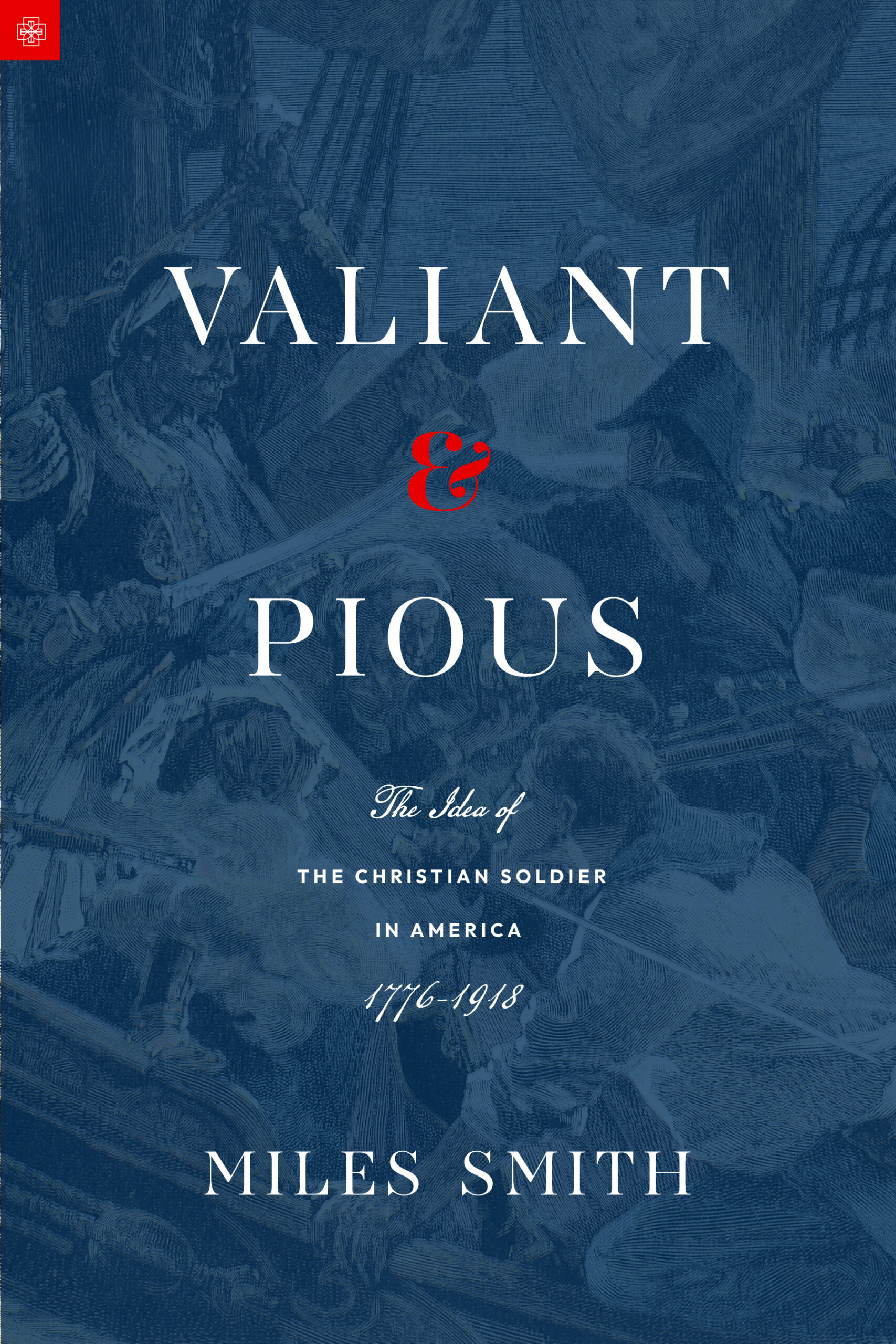
Valiant & Pious
The Idea of the Christian Soldier in America, 1776-1918
A Protestant military for a Protestant republic
Was the United States Army a Christian institution? In Valiant & Pious, Miles Smith argues that between the election of George Washington and the presidency of Andrew Jackson, the American republic carried forward the historic Protestant and Western tradition of war and statecraft. The nation could be a novus ordo seclorum devoted to natural rights while remaining a conservative Protestant republic, defended by a conservative Protestant military. That Protestant character was not merely social or religious but political and statutory. Religion in the Early Republic Army and Navy was mandatory and institutionalized, and the officer corps trained at West Point became the institution most likely to preserve a classical and Protestant account of the relationship between war and religion.
Smith tells this story through a series of formative episodes: the Revolution, the creation of the commander-in-chief, the Quasi-War with France, the Barbary conflict at Tripoli, the founding of West Point, the War of 1812, and the Indian Wars. He then traces how the Evangelical military revolution of the Jacksonian era tore down the old semi-establishmentarian order and, by 1900, helped make America itself a sacred object worth fighting for. The result is a fresh account of the Christian soldier in America and a needed addition to scholarship on religion and the U.S. military between the Revolution and the Civil War.
$34.95 $24.95 Limited-time launch price!
About the Author

Miles Smith
Miles Smith IV is Associate Professor of History at Hillsdale College. A historian of religion and politics in the Early American Republic, he attended the College of Charleston and received his Ph.D. from Texas Christian University. His research centers on the U.S. South and the Atlantic world, with particular attention to intellectual history, religion, and the nexus of church, state, and war. He is the author of Religion & Republic: Christian America from the Founding to the Civil War (Davenant Press, 2024), the first volume in the American Theology Series, and he edits nineteenth-century works of historical theology. Smith has written for Ad Fontes, Mere Orthodoxy, The Gospel Coalition, Public Discourse, The Federalist, and The University Bookman. He lives in Hillsdale, Michigan, with his wife, Jaime.
Publication Details
- Publisher: Davenant Press
- ISBN-13: 978-1-949716-88-7
- Format: Paperback
- Dimensions: 6 x 9 in.
- Publication Date: October 1, 2026
- Pages: 250
- Author: Miles Smith
Endorsements
-
“In his new book, Miles Smith has done one of my favorite things as a historian. He has insisted that contemporary audiences take the people of the past on their own terms. Rather than reducing historical moments to simplistic analogues and anecdotes for today’s debates, as so many others do, he has offered a rich picture of a previous era. On the basis of thorough and extensive research, Smith’s work contributes greatly to the ever-important conversations concerning the cross and the sword, as well as the underdeveloped study of evangelicalism in America’s 19th century. I highly recommend this for the scholar and laity alike.”
— Tim Padgett, Resident Theologian, The Colson Center
-
“In Valiant & Pious: The Idea of the Christian Soldier in America, 1776-1918, Miles Smith tells the story of the relationship between Protestant Christianity and the American military in the Early Republic. Smith shows how late eighteenth- and early nineteenth-century American military institutions, especially in the academies, preserved and perpetuated traditional Protestant teaching on war, even as they distinguished (more carefully than would their Jeffersonian, Jacksonian, and evangelical successors) the temporal ends of the nation from the eternal ends of the church. This book further consolidates Smith’s reputation as of one of the finest emerging historians of early American religion and society.”
— Scott R. Swain, President, James Woodrow Hassell Professor of Systematic Theology, Reformed Theological Seminary, Orlando
-
“Miles Smith has written a worthy and timely follow-up to Religion & Republic. He continues to reorient our perspective on Christianity’s political and social place in America’s early history. With Smith’s focus in this volume, we better see the thoughtful and classically Protestant political theology that informed the young republic’s military institutions and soldiers. Those engaged in contemporary discussions of religion’s role in our political and social institutions should take note.”
— Adam Carrington, Associate Professor, Archer Endowed Position in History & Political Science and Co-Director of the Ashbrook Center at Ashland University
-
“Miles Smith traces the forgotten rivalry between two Protestant visions of the American military—the institutional restraint of the Episcopal and Congregationalist officer corps, and the democratizing fire of Evangelical frontiersmen like Jackson and Houston. What emerges is a provocative argument: when Evangelicals dismantled the old semi-establishmentarian order, they inadvertently made America itself the sacred object worth fighting for. Smith writes with a historian’s rigor and a theologian’s instinct, and the result is essential reading for anyone who wants to understand why American Christians still struggle to think clearly about war.”
— Capt. James Winston, United States Marine Corps (Ret.)
More Endorsements (5)
-
“In Valiant & Pious, Miles Smith offers a compelling and nuanced examination of how Christianity intertwined with military ethos in the Early American Republic. Professor Smith’s research reveals the U.S. Army and Navy as bastions of classical Protestant realism amid the democratizing fervor of evangelical awakenings. Smith’s insightful analysis highlights the officer corps’ role in upholding hierarchical order and a sober view of human nature, contrasting sharply with the anti-institutional innovations of the era, and provides fresh perspectives on the philosophical underpinnings of American warmaking. This book is essential reading for anyone seeking to understand the enduring tensions between faith, politics, and soldiery in shaping the nation’s identity.”
— Khalil Habib, Associate Professor of Politics, Hillsdale College
-
“Miles Smith uses the history of the American military to make an intriguing argument—that from its beginning the nation’s military establishment, with establishmentarian instincts and strong commitments to natural law, upheld traditional, or “civilizational,” Protestantism. Thus, the military with West Point in the lead long treated warfare as primarily defensive. Andrew Jackson exploited democratic and evangelical forces, but continued to view warfare in terms of natural law (and so still primarily defensive). Beginning with the Mexican War and continuing to the present democratic and biblicist evangelicals, who have viewed American ideals as sacred, abandoned natural law, and promoted offensive wars despite the reservations of the military establishment. This well-documented study poses important considerations for all questions concerning the Christian character of the United States.”
— Mark Noll, Author of The Civil War as a Theological Crisis
-
Miles Smith has a gift for asking new and interesting questions even about topics that have received much scholarly and popular attention before—in this case, the relationship of the Christian faith and war in early America. The result is a remarkable and deeply researched account that informs, fascinates, and challenges in equal measure, reminding us that there is much more than meets the eye—even to the history we thought we knew well.”
— Nadya Williams, Book Editor, Mere Orthodoxy; Interim Director, Ashland University
-
“Written by an authority on the Early Republic, this new book examines the view that the United States could be both a new nation founded on Lockean principles of natural rights and a conservative Protestant republic defended by a conservative military. In clear and vigorous prose, Miles Smith unfolds a fascinating story about this crucial time, when citizens were wrestling with the best way to express ordered liberty. The author’s references to current events in American politics and culture only enliven his history; they never obtrude. Well worth reading and considering by anyone concerned about the relationship between religion and the American Republic.”
— David Hein, Distinguished Teaching Fellow at the Russell Kirk Center for Cultural Renewal and author of Teaching the Virtues: An Essay in Practical Philosophy
-
“Miles Smith’s Valiant and Pious: The Idea of the Christian Soldier in America 1776-1918 is an enlightening investigation into America’s attempt to defend liberty of conscience even as it sought to maintain a Protestant hierarchical military that could effectively govern soldiers in the violence of war. Smith’s scholarship skillfully engages the largely overlooked period between the American Revolution and the Civil War. He does so by plumbing the tensions between classic Protestantism’s views of war and those of the emerging democratic and evangelical movements of the era. Valiant and Pious offers the opportunity to consider the conflicting agendas of America’s early political leaders, even as the military sought to preserve order and authority in the context of the explosive growth of America’s newer popular religious movements. This important study presents fresh perspectives on American military history leading up to the Civil War.”
— Dr. Peter A. Lillback, President, Westminster Theological Seminary, Philadelphia
From the Book
“During the Early Republic era, American military leaders and politicians were careful to avoid sacralizing war—or America itself, for that matter—even as they built semi-establishmentarian structures into the United States Army and Navy. During that same era, particularly after the founding of the United States Military Academy at West Point, the officer corps of the U.S. military was the institution most likely to perpetuate a classical and Protestant approach to the relationship between war and religion. Said more sensationally, during at least the first 80 years of the American republic’s constitutional life, the average U.S. Army and Navy officer—often conservative Congregationalists or Episcopalians, and occasionally Presbyterians—was a more educated and reliable political theologian than the average Evangelical minister. Military officers trained at West Point and later at the United States Naval Academy in Annapolis were more likely than Evangelicals to have any historic classical or historically Protestant intellectual catechesis.”
From the Preface
Table of Contents
- Acknowledgements
- Foreword (Larry P. Arnn)
- Preface
- Introduction
- 1. American Revolution
- 2. Commander-in-Chief
- 3. Quasi-War
- 4. Tripoli
- 5. West Point
- 6. War of 1812
- 7. Indian War
- 8. The Evangelical Military Revolution
- 9. American Holy War
- 10. Conclusion
- Bibliography
- Index


