By Michael Laffin
Note: This essay was first published in the print edition of Ad Fontes.
Introduction
Discussions of Martin Luther’s writings on society, ethics, and politics in the English-speaking world tend to focus on his teaching concerning the two kingdoms, which divides authority into temporal and spiritual realms. Often overlooked is the larger theological framework within which the two kingdoms teaching is situated. In particular, his teaching concerning the three institutions (or “estates,” as they are more commonly called) has been, with a few important exceptions, largely neglected. According to Luther, Scripture references institutions or “con-creatures” (concreatae sint),created together with human beings, that bear God’s promise to provide for human creaturely life, especially in its social aspects.[1] The three institutions are, Luther says, the church (or ecclesia), the household economy (or oeconomia), and politics (or politia). When Luther’s treatment of the three institutions is neglected, the teaching concerning the two kingdoms tends to take on a life of its own, leading to quietist interpretations of the Christian’s relation to governmental authority, or a division of human life into autonomous “worldly” and “spiritual” spheres, the latter understood in an individualistic and inward sense, none of which was intended by Luther.
In part, wariness of Luther’s political theology stems from appropriate concerns about how it was misused in early twentieth-century Germany to justify subservience to Hitler’s Nazi regime. A proper understanding of the institutions and how they function in Luther’s thought, however, will show that they help us to subject earthly authority (churchly, political, economic) to the criticism of divine revelation and force into the open the idolatry behind any claims of absolute authority by any of the three institutions. Such claims were made primarily by the church hierarchy in Luther’s time, the state in Nazi Germany, and, some might claim, by the economy in our own time. Further, without attending to the teaching on the institutions, Luther’s social and political ethics become separated from his larger theological commitments, dissolving their organic unity. The three institutions can give us much needed critical purchase as we seek to faithfully inhabit our vocations, and the institutions that support our vocations, in the world today. Therefore, my purpose is to set forth Luther’s teaching on the three institutions, indicating its inseparable connection to his larger theology of the Word of God, and then to spell out its implications for the way we might think about social life, ethics and politics.
The Three Institutions and the Word of God
Despite their recent neglect, the three institutions play a much greater role in Luther’s self-description of his theological undertaking than do the two kingdoms.[2] Oswald Bayer notes that, in his Catechisms and in writings like “On Councils and the Church,” the “Confession Concerning Christ Supper,” and in numerous Table Talks, Luther refers to the three institutions as embodying the Reformation. As Bayer writes, “…in Luther’s self-presentation the three estates [institutions] have far greater weight than the two kingdoms, which never appear in these summary and testamentary contexts.”[3] Their importance for Luther is linked to their role in interpreting Scripture. In a Table Talk, he argues that we should read the Bible in the light of a three-fold division of God’s work into “the household [Oeconomiam], the government [politiam], the church [ecclesiam]. If a verse does not fit the church,” he says, “we should let it stay in the government or the household, whichever it is best suited to.”[4] Likewise, he writes in his “Confession Concerning Christ’s Supper” that “these three religious institutions or orders are found in God’s Word and commandment.”[5] Hans Ulrich picks up on this language and refers to these three as “institutions,” and describes them as “marked place(s) of living within God’s governance and government insofar as this expresses God’s promise.”[6] They are established by the Torah, the law of God. The institutions, then, describe the shape and form of the divine commands—commands which promise—as found in Scripture concerning the establishment of and provision for creaturely human life. They are, as Ulrich writes, “an invitation to explore God’s will and to receive God’s cooperation.”[7] Understood in this manner, the institutions are best described not as natural structures of life given apart from God’s Word of salvation but as means of attuning us to the way creaturely reality is shaped and sustained in its encounter with God’s living Word.
What is suggested by the term “institution,” as Bayer notes, is the coming together of the divine Word and the material element. The material element, or nature, does not have innate capacities, but instead is continually animated by the ever-present Word. The focus on the all-present Word, and the Lutheran Christology associated with it, means the incarnate Jesus Christ at the right hand of the Father is simultaneously the eternally ubiquitous Son of God who creates and preserves the world according to His one person. Therefore, the institutions preserve the oneness of the command of God while upholding the appropriate distinction between creation and redemption.
“The institutions are best described not as natural structures of life given apart from God’s Word of salvation but as means of attuning us to the way creaturely reality is shaped and sustained in its encounter with God’s living Word.”
Exposition of the Three Institutions
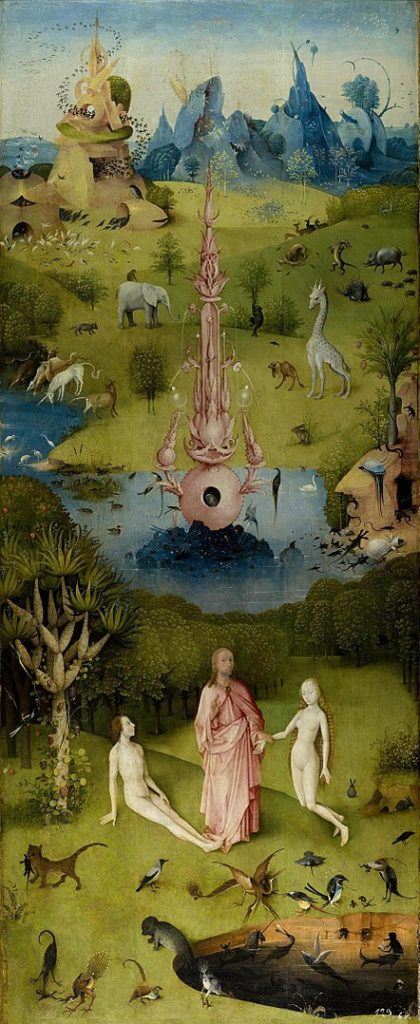
But what exactly are these institutions? Luther’s most concentrated spelling out of all three occurs in his Lectures on Genesis. In interpreting Genesis 2:16-17, God’s first address and command to Adam regarding eating from the trees in the garden, Luther writes, “Here we have the establishment (institutio) of the church (Ecclesia) before there was any government of the home (Oeconomia) and of the state (Politia), for Eve was not yet created.”[8] In other words, “The temple is earlier than the home,” and therefore the church is the primal institution.[9] The stress on the Word of God is central to Luther’s interpretation of the passage: “Here the Lord is preaching to Adam and setting the Word before him.”[10] What we get in these verses is God’s sermon to Adam—the Word is preached to him, the same Word which created and continually governs the world. If Adam had remained in paradise, Luther argues, this sermon from the Lord would have served as his Bible, and the tree of the knowledge of good and evil “would have been the church at which Adam, together with his descendants would have gathered on the Sabbath day.”[11] However, the church’s priority is not merely temporal; it is also the institution definitively indicating the nature of human social life as established by divine speech. As Ulrich puts this point, “The grammar of cooperation and living with God is to be found paradigmatically within the church, the Christian congregation and community. Here is the place where people learn to be aware of God’s presence.”[12] Crucial to Luther’s account of the church is God’s grace in providing humanity with a place where the Word of God can be heard in certainty and humanity can respond, confident that its worship is pleasing to God. As Luther writes, “Adam had need of this command concerning the tree of the knowledge of good and evil, namely, that there should be an outward form of worship and an outward work of obedience toward God.”[13] Thus, the establishment of the church is both God’s promise to speak to and address God’s human creature and the enablement of the creature for faithful response to the divine address.
“‘The temple is earlier than the home,’ and therefore the church is the primal institution.”
The second institution that Luther exposits in the Lectures on Genesis is the household economy (oeconomia), which includes marriage and the family, business, work, and education.[14] He finds this institution established in God’s Word—“It is not good that the man should be alone” (Gen. 2:18)—and in God’s call for a man to leave his mother and father and cleave to his wife, such that “they become one flesh” (Gen. 2:24).[15] Interestingly, Luther brings larger social implications to the fore in connection with the family. He says that Adam enjoyed innocence in paradise and lacked nothing as he was enveloped in God’s gracious presence. So, then, what could it mean that it was not good for Adam to be alone? Luther answers that “God is speaking of the common good or that of the species, not of personal good. The personal good is the fact that Adam had innocence. But he was not yet in possession of the common good which the rest of the living beings who propagated their kind through procreation had.”[16] And again here, Luther stresses the centrality of the Word of God and the way it enables human beings to inhabit the places of human social life with the assurance of God’s promise to provide. Just as the promise and command concerning the church gave humanity a definite form, time, and place for worship, so the institution of the oeconomia gives humanity a definite form, time, and place for human procreation, labor, and sustenance.[17]
Finally, Luther explicates Genesis’ account of the institution of the “state” (again, politia in Latin), which indicates God’s promise to care for and rule human political life. Luther is not always consistent regarding the status of the institution of the political, sometimes suggesting that it is a postlapsarian measure necessitated by human sinfulness, but at other times suggesting it came into being with the creation of human beings, since human life has always been subject to God’s rule. The overall evidence, however, lends to reading the political institution as part of the original divine establishment alongside the church and household-economy.[18] Luther interprets the political order as God’s ordinance by means of which God exercises His unitary rule over the world. The world is thus God-infused, with the continual existence of all human societies and political arrangements dependent upon the divine Word which alone establishes the enduring forms of human social life. In his “Exposition of Psalm 127 (1524),” with reference to the psalm’s famous first verse, “Unless the Lord guards the city, its watchmen keep awake in vain,” Luther shows how all communities are “masks” that express God’s dominion. He does not deny that, in the fallen world, sin has infected all communities, and that they can become so corrupted that they are rightly called “anti-institutions,” but to the extent that they provide peace and allow for human cooperation, this is a sign of God’s active presence and work. And for as long as the world endures, the divine promise to establish and govern political life gives us hope in finding and inhabiting such communities of peace.
Luther took what he saw to be the papacy’s attempt to unify the authority of all three institutions in the singular hands of the church to be the great social and political threat of his time. In particular, he saw the danger posed by a church hierarchy that promised the salvation that belonged to Christ alone, subjecting all of human political and economic life to the papacy. He perceived this to be happening in the papacy’s claim to decide unilaterally on doctrine, in its use of indulgences and the banking system to further its own causes, and in its attempts to subject temporal authority to its rule. Whether Luther’s judgment on this matter was correct, we can nonetheless see why Luther took his teaching on the institutions to be so central to his understanding of the Reformation. In realizing the importance of each of the three, and of the rightful limits they place on one another, the institutions free creatures to respond faithfully to the divine promises without grasping after idols that falsely offer salvation or justification outside of these promises.
The idols we worship are embodied in social formations and tend toward absolutization. As Luther argues in his Large Catechism, an idol or a god is that to which we look for all good things, and when we look to something other than the divine promise, we slavishly absolutize the idol and, in extreme cases, seek to subject all of human life to it.[19] Again, Luther worried that the papacy and church hierarchy had come to be the social expression, or institutional form, of the idolatry that sought salvation in human righteousness. So while there were undoubtedly political motivations behind the Reformation, Luther saw the re-establishment of local princely authority as giving space for receiving the promise of divine rule, pulling it out from under an imperial papacy that sought to assume the mantle and promise of all three institutions under its singular rule. The attempt to grasp the authority that belongs to Christ alone is, for Luther, the very definition of an “anti-institution,” and the one claiming such authority is the very definition of the “anti-Christ.” This goes a long way in explaining Luther’s harsh rhetoric against the papacy and in defence of princely rulers. The theological convictions motivating this stance become easily obscured if explained simply in terms of a doctrine of the “two kingdoms,” with a simplistic “spiritual/worldly” distinction, rather than in terms of Luther’s richer account of the three institutions within which the “two kingdoms” conceptually operates.
“An idol or a god is that to which we look for all good things, and when we look to something other than the divine promise, we slavishly absolutize the idol.”
The Importance of the Three Institutions for Reformational Social and Political Theology
Given the theological context for Luther’s understanding of the three institutions, and given a sense for what constitutes their material context, what is their importance for contemporary Protestant ethics or politics? Most importantly, attention to the three institutions ensures that reflection on questions of ethics and politics remains rooted in the patterns of the divine promises as found in Scripture; it furthermore allows for discerning the concrete contours in which a commitment to sola scriptura bears materially on such questions. It means that we read and interpret creation in the light of Scripture and not as an independent source of revelation alongside Scripture. It also prevents appeals to natural law or “unassisted” human reason from becoming untethered from the words and promises of Scripture; in other words, the framework of the three institutions prevents Scripture from being abandoned for the imaginings of the human heart. In short, Luther’s three institutions discipline our political and ethical reflection in conformity with the “deep grammar of Scripture.”[20] The focus on revelation as found in Scripture, rather than read out of the created order independently of Scripture, also means the institutions are circumscribed and developed in response to Scripture, not by reference to sociological formations.
The concept of institutions tunes our attention to the places in Scripture where God has set forth His good intentions for human life, helping us discern the faith or idolatry embodied in all actual social-political formations. For Luther, the final cause of any healthy social or political community is the promising Word of God, but in their distorted “anti-communal” form, such communities are warped by the unbelief that refuses to trust and accept this Word. Reflection on the institutions, which is to say, on the shape of the divine promises to care for human life as revealed in Scripture, brings to light that to which our hearts cling in social and political life. The institutions illuminate faith and idolatry. They ask us, do particular economic configurations reveal trust in the divine promise that the earth will provide for all of God’s creatures when inhabited with trust in our Heavenly Father or betray an idolatrous reliance on human domination to leach sustenance from a groaning earth? Does a given political configuration reveal our denial that God ultimately rules human affairs, leading us to trust human force and power alone to realize peace, or does it reveal trust that peace is finally the work of the slain lamb? Does our view of the church suggest that it must grasp after power and influence to secure its position in society, or do we trust Christ’s promise that He is with us to the end of the age, such that we perceive humility and weakness as true marks of the church and as the sign of God’s power at work in reconciling the world?
“Our temptation, which results from unbelief, is to absolutize the institutions in a human attempt to possess that which can only be received as a gift of God.”
Our temptation, which results from unbelief, is to absolutize the institutions in a human attempt to possess that which can only be received as a gift of God. So, rather than embracing creaturely limits, the state attempts to provide the peace, security, and cooperation required for human flourishing by any means necessary; the “market” becomes a god to which communities, livelihoods, and the common good are sacrificed; the church strives above all else to recapture a position of political influence. But in turning human hope to the state, the economy, or the church itself, we risk getting pulled into the grasping vortex of one or the other in a desperate attempt to secure by our own means that which God has promised in His Word to provide. Bayer describes such attempts as, “lust for future things (concupiscentia futurorum)…an unhealthy domination by the future and the flight from the present that accompanies such preoccupation.”[21] On the other hand, trust in the divine promises as revealed in the divine Word, promises which the teaching on the institutions alerts us to, allows us to inhabit these places of promise in the present in the certainty of divine provision and favour. We can turn our full and patient attention to the neighbor, free from the distorting pressure that comes from the false belief that the future is entirely ours to secure, or even from the false belief that the justification for our life depends upon getting our service to our neighbor right. Rather, Luther’s teaching on the institutions provides the grammar for living in places where we are set between God and neighbor, enabling us to freely serve as conduits of God’s love to God’s creatures. We become, as Luther would put it, “Christ’s one to another.”[22]
Dr. Michael Laffin is Lecturer in Ethics at the University of Aberdeen. His research focuses on Christian ethics and political theology. His publications on Martin Luther’s theology include a monograph, entitled The Promise of Martin Luther’s Political Theology: Freeing Luther from the Modern Political Narrative (Bloomsbury T&T Clark, 2016).
[1] See Bernd Wannenwetsch, “Luther’s Moral Theology,” in The Cambridge Companion to Martin Luther, ed. Donald McKim (Cambridge: Cambridge University Press, 2003), 130.
[2]Although there is not space for the argument here, it is worth noting that two “kingdoms” can be misleading when speaking of Luther’s theology. More accurate would be to see his early language of “kingdoms” in the light of his later language of “regiments,” which points to the fact that God rules with God’s “left and right hand.” The emphasis in the language of “regiments” is aimed at the unity of God’s rule over all of human life and history, whereas the “kingdoms” suggests separate realms, perhaps on the order of Augustine’s two cities (civitates). In his later writings, when Luther wants to make this latter distinction, he speaks of two “ecclesiae,” or two churches marked by that which they worship, either the true God or idols. Thus, Luther is able to speak in critical fashion of the “earthly” city or church, as does Augustine, while his acknowledgment of the two “regiments” leaves space for the positive sense in which God rules through temporal authorities. Talk of two “kingdoms” threatens to collapse this difference and leads to the problems previously mentioned, namely quietism or false removal of the church from the “public” sphere.
[3] Oswald Bayer, “Nature and Institution: Luther’s Doctrine of the Three Estates,” in Freedom in Response: Lutheran Ethics: Sources and Controversies, trans. Jeffrey F. Cayzer (Oxford: Oxford University Press, 2007), 94. Note Bayer’s language of “estates” to describe what I am calling “institutions.” Luther’s terminology varies and he interchangeably uses the terms “orders” (ordinations, ordo, Ordnung), “hierarchies” (Hierarchies), and “offices” (Amt), in addition to “estates” (Stand) and “institutions” (Stiften). However, despite the fluidity of the terminology, the underlying concept remains constant in Luther’s writings.
[4] Marin Luther, Luther’s Work’s 54: Table Talk, 446 (hereafter, the English translation of Luther’s Works referred to as LW); D. Martin Luthers Werke Weimarer Ausgabe, WATR 5.218, 12-18 (hereafter the Weimarer Ausgabe is referred to as WA).
[5] LW 37:365.
[6] Hans Ulrich, “God’s Commandments and their Political Presence: Notes of a Tradition on the ‘Ground’ of Ethics,” Studies in Christian Ethics 23.1 (2010), 45-6. My decision to refer to the estates as “institutions” follows Ulrich and brings to the fore the importance of their being “established” or “instituted” by the divine speech.
[7] Ulrich, “On the Grammar of Lutheran Ethics,” in Karen L. Bloomquist, ed. Lutheran Ethics at the Intersection of God’s One World (Geneva: The Lutheran World Federation, 2005), 35.
[8] LW 1: 103; WA 42, 70, 3-5.
[9] LW 1:104.
[10]LW 1:105.
[11] LW 1:105.
[12] Ulrich, “On the Grammar of Lutheran Ethics,” 41.
[13] LW 1: 109.
[14] In his “Exposition of Psalm 127 (1524),” Luther notes that he borrows the concept of oeconomia from Aristotle, LW 45:322.
[15] LW 1:115, 138-39.
[16] LW 1:115-16.
[17] Luther gives further indications of what the delightful labor of paradise would have entailed when he exegetes Gen. 2:15, “And so the Lord God took man and placed him in the Garden of Eden to work it and to guard it,” LW 1:101-102.
[18]For a full discussion of the inconsistency in Luther’s account of politia, including the various passages throughout his writings where it is discussed, see my The Promise of Martin Luther’s Political Theology: Freeing Luther from the Modern Political Narrative (London: Bloomsbury T&T Clark, 2016), 183-87.
[19] Luther, “The Large Catechism,” in Robert Kolb and Timothy J. Wengert eds. and Charles Arrand et al. trans. The Book of Concord: The Confessions of the Evangelical Lutheran Church (Minneapolis: Fortress Press, 2000), 386.
[20] This phrase is taken from Brian Brock, “On Generating Categories in Theological Ethics: Barth, Genesis and the Ständlehre,” Tyndale Bulletin 61.1 (2010), 66.
[21] Oswald Bayer, “‘I am the Lord your God…’: The Significance of the First Commandment as a Basis for Ethics,” in Freedom in Response, 58. Luther speaks of concupiscentia futurorum in his commentary on Ecclesiastes, LW 15:50.
[22] Luther, “The Freedom of a Christian,” LW 31:368.