
-

|
How the Reformation Vanquished Death
For the Christian, the threat of death, in whatever form it comes, does not have the final word. Jesus said it this way: “Unless a grain of wheat falls into the earth and dies, it remains alone; but if it dies, it bears much fruit” (John 12:24).
-

|
Whether One May Flee From a Deadly Plague
The Black Death, which from 1347 to 1350 swept out of China or India to the Crimea and thence into Europe and as far as Iceland, killed one-fourth of the population of Europe.
-

|
A Theology of Proportion
A Review of God in Himself: Scripture, Metaphysics, and the Task of Christian Theology, by Steven J. Duby (InterVarsity Press Academic, 2019) by James Clark When considering how to engage in theology, two inclinations tend to be opposed. The first prioritizes “a speculative doctrine of God driven by natural theology or ‘metaphysics’” which inordinately colors…
-

|
The Decline of the Magisterial Tradition and the Rise of the Cromwellian Consensus (Pt. 1)
After the conclusion of the English Civil War, the tensions between two Puritan emphases began to become apparent: the ideal of the “godly magistracy,” which assumed general uniformity in religious practice, and the tendency towards a “gathered church,” which had encouraged the gathering of the “godly” in separate assemblies.
-

|
“Presbyterians” and the Making of an Informal Establishment (Pt. 2)
So far, I have worked to argue that the English Reformed tradition had already become considerably less magisterial by the mid-seventeenth century. Next, I want to suggest that Cromwell’s move towards supporting a kind of multiple establishment had echoes in the early republic, first in the abortive attempts to create shared establishments that would support…
-

|
The Art of Protestant Learning
One of the misguided but persistent assumptions about English reformers in the sixteenth century is that they rejected the study of ancient languages, rhetoric, grammar, philosophy, and poetry in their efforts to defend the supremacy of Scripture.
-
|
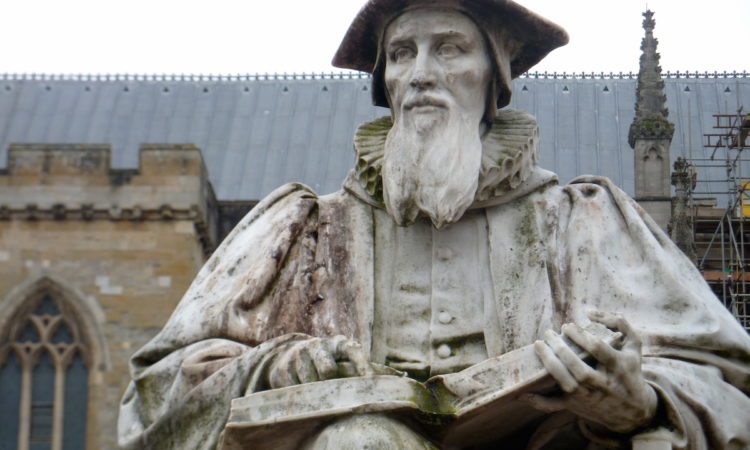
Becoming Holy with Richard Hooker
By teaching two kinds of righteousness, one imputed and one actual, Hooker makes room for us both to truly become holy and for our works to contribute to that holiness.
-

|
Revisiting “The Shape Fallacy”: A Response to Ben Jefferies
I am concerned with something bigger than any one late modern prayer book: how the Dixian shift to thinking of the prayer book in terms of “shape” has affected the virtues of the prayer book tradition.
-

|
The Lamentation of a Sinner by Katherine Parr: A Review by Rhys Laverty
Devotional retrieval must accompany theological retrieval. To that end, New Whitchurch Press’ republication of The Lamentation of a Sinner is prescient.
-

|
Hemmingsen on Three Kinds of Justice
Christian justice, as Hemmingsen defines it, is “the obedience of Christ imputed to the one who believes.” The one who is just “evangelically,” or “according to the gospel,” is the one whose sins are forgiven and to whom the justice of the Son has been imputed.
AD FONTES