
-

|
This Week in Church History: August 31: Henry VIII Excommunicated
On this day in 1535, Pope Paul III made the break between the English state church and the Roman church conclusive when he excommunicated England’s King Henry VIII. The circumstances leading up to Henry’s break with the established church are well known, of course. The king wanted a son and was convinced he would not…
-

|
This Week in Church History: Founding of Harvard College (1636)
September 8, 1636 marks the founding of Harvard College in what was then called New Towne, but would come to be known as Cambridge, MA in later years. The college was originally founded as New College but was renamed two years after opening in honor of one of the school’s first benefactors, the Rev. John…
-

|
This Week in Church History: Death of Anne Bradstreet, September 16, 1672
On this day in 1672 the famous Puritan poet Anne Bradstreet died in North Andover, MA. Bradstreet along with her husband Simon had moved to the Massachusetts Bay Colony in 1630 and had first helped settle the new settlement of Boston before moving on to what was then called Newe Towne in the early 1630s. Newe Towne would eventually…
-

|
This Week in Church History: Marburg Colloquy Introduction
Other posts in the series: Day 1 (October 1) Day 2 (October 2) Day 3 (October 3) Day 4 (October 4) October 1 will mark the anniversary of the beginning of the Marburg Colloquy, held in 1529. Over the next several days, we’ll be publishing a series of posts going through the day-to-day happenings at…
-
|
This Week in Church History: Marburg Colloquy Day One (October 1)
Other posts in the series: Introduction Day 2 (October 2) Day 3 (October 3) Day 4 (October 4) In the second part of our series on the Marburg Colloquy, we’re looking at the events on the first day of the Marburg Colloquy, October 1, 1529. Beginnings of the Colloquy The colloquy began informally on the morning…
-
|
This Week in Church History: Marburg Colloquy Day 2 (October 2)
Other posts in the series: Introduction Day 1 (October 1) Day 3 (October 3) Day 4 (October 4) What we are referring to as day two of the colloquy is, technically speaking, day one. Though the discussion began informally on Friday the 1st between Luther, Zwingli, Melanchthon, and Oecolampadius, the colloquy did not officially begin…
-
|
This Week in Church History: Marburg Colloquy Day 3 (October 3)
Older posts in the series: Introduction Day 1 (October 1) Day 2 (October 2) Day 4 (October 4) The third day of the Marburg Colloquy is the day that the wheels basically came off the cart. The first day featured informal discussions with a small group and was followed by more official (and similarly fruitless) discussions…
-
|
This Week in Church History: Marburg Colloquy Day 4 (October 4)
Previous posts in the series: Introduction Day 1 (October 1) Day 2 (October 2) Day 3 (October 3) In this final post, we’re going to recap what the final day of the colloquy and then discuss the colloquy’s importance within the larger story of the Reformation. A Brief Summary of Day 4 (October 4) of the…
-

|
This Week in Church History: Latimer and Ridley Burned (1555)
October 16 marks the anniversary of the martyrdom of Hugh Latimer and Nicholas Ridley by Queen Mary of England. Together with the Archbishop of Canterbury and author of the Book of Common Prayer, Thomas Cranmer, these three men make up the Oxford Martyrs. All three died by burning in Oxford, thus the term “Oxford Martyr,”…
-
|
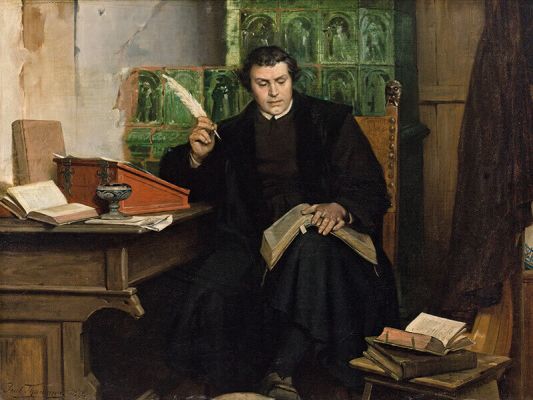
September 21st: Commemorating Luther’s Translation
[vc_row][vc_column][vc_column_text]September 21, 1522: Luther’s Translation of the NT Published Rome’s Censure of Scripture The council of Trent (1545-1563), in its 4th session, stated: “But if any one receive not, as sacred and canonical, the said books entire with all their parts, as they have been used to be read in the Catholic Church, and…
AD FONTES