A conference on Christian education might, at first glance, seem off-brand for the Davenant Institute. Since its foundation, Davenant has focused on recovering early Protestant insights on issues like ecclesiology, Christian cultural engagement, and the relationship of theology to philosophy (especially political philosophy). The institute’s Protestant ressourcement has centered on difficult scholastic and humanist texts, often unread by contemporary scholars, much less pastors and laypeople. Its publications have sought to apply sound historiography in order to complicate popular “just-so stories” about modern life, and to challenge Christians to the hard work of wisdom. In other words, Davenant’s mission would seem to concern issues at the highest level, issues of the adult world.
Of course, as the speakers at this year’s Convivium Irenicum could tell you, a strong distinction between “high-level,” “adult” questions like politics and questions of education is a recent innovation. Both Plato and Aristotle, in their most famous works of political thought, treated education as of vital importance. Many Church Fathers and Medieval philosophers concerned themselves with pedagogy and the training of the young. As for the Protestant Reformers, far from dwelling in ivory towers, many of them actually worked as schoolteachers and all considered the education of the populace as central to their enterprise. Only in late modernity has “educational theory” been cordoned off as its own field and dissociated from the great questions of truth, being, God, and justice.
The 2021 Convivium, held at the Davenant House in South Carolina, sought to reintegrate these questions in a wide-ranging conversation on “Education and the Kingdom of God.” Founder and president Brad Littlejohn set the stage in his opening address, where he described Christian education as a training in “naming the world,” a participation in God’s own intimate knowledge of creation. Like studying a map before crossing a mountain range, the Christian student’s training in the two books of nature and Scripture aid in journeying through God’s world with wisdom.
Drawing on this notion of education for wisdom and discernment—as opposed to rigid indoctrination—the Convivium itself was structured with an eye to open conversation. Each presentation was followed by 20-40 minutes of discussion, and several presentations were not monologues at all, but guided seminars based on preselected texts. Of these, a highlight was Clifford Humphrey’s plenary discussion, “Must Christian Education Be Churchly Education?” which drew on excerpts from Aristotle’s Ethics and Politics, as well as selections from James K.A. Smith and C.S. Lewis. What emerged was a lively exchange that ranged from the place of music in education to the value of protective subcultures for Christian students. Dr. Humphrey challenged us to reconsider the content-heavy and intellectualized approach favored by many Christian schools today, divorced as it often is from the communal, liturgical formation offered by the church. On the other hand, the discussion led us to scrutinize the defensive posture that often accompanies the church’s educational endeavors. “What are we defending against?” it was asked. The seminar ended with reflections on faith in God’s provision for students and the need to ground Christian education in prayer.
Another point confirming the appropriateness of the Convivium’s theme is that Christian education in the US is currently having its own “ad fontes” moment. The Classical Christian education movement continues to grow and exert influence in new arenas. Its leaders claim to offer a course of study that is not only faithful to God’s Word, but also steeped in a tradition as old as ancient Athens. This year’s Convivium was both a celebration and a critical examination of Classical Christian education. The Davenant Institute’s watchword is indeed the “ad fontes” of the Renaissance humanists. But to return “to the sources” does not always result in a simple solution to present-day problems. Indeed, the effect of close examination of the past is often that our easy narratives are refuted and the problems become even more complicated. The spirit of the Convivium Irenicum is faithful acceptance of this complexity and willingness to let difficulty produce wisdom.
This spirit was embodied in the presentations, beginning with those delivered by the keynote speaker, Gene Edward Veith. Dr. Veith is one of the “founding fathers” of Classical Christian education, and his work has long helped to hone the vision of classical schools. His keynote address, “The Liberal Arts and the Art of Service,” catalogued the variety of approaches present in the Classical Christian movement, before launching into a historical analysis of the schools of the Lutheran Reformation. A takeaway from Veith’s paper is that the liberal arts have not always been spoken of in the same way, and in fact medieval history saw conflicts between the different arts of the classical trivium (grammar, logic, and rhetoric). With the late middle ages came a resurgence of grammar and rhetoric against the logic that was ascendant in the schools. We infer that a present-day revival movement for the liberal arts must answer the question, “Which ones?” And more importantly, “Why?” Veith’s history of the German Lutheran schools, or gymnasia, revealed an educational philosophy that balanced the trivium with Christian catechesis, and one that cultivated the arts for the sake of service to neighbor, not for empty sophistication. His guided seminar on the writings of Johann Sturm helped flesh out the praxis of this model.
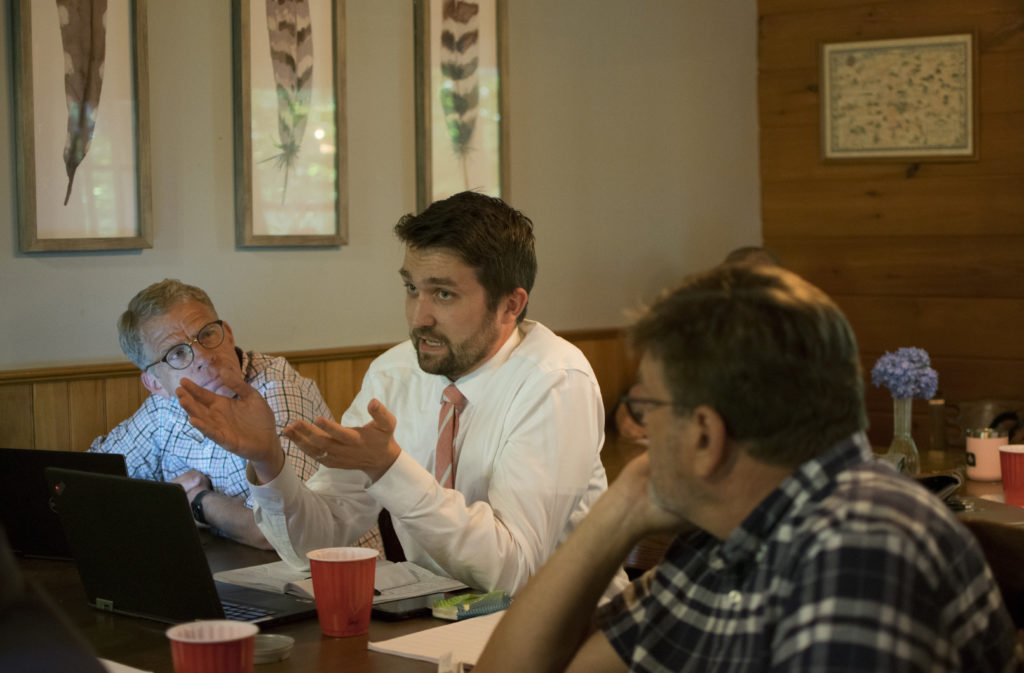
Michael Lynch, in his plenary session entitled “Elitism or Egalitarianism? The Lessons of Early Modern Classical Education,” sought even more pointedly to hold the mirror up to present classical approaches by surveying the historical record. Dr. Lynch’s analysis of 16th– and 17th-century grammar school and university curricula yielded surprising findings: among them, first, that all childhood instruction was geared toward preparing for university; and second, that the main substance of this preparation was absolute fluency in Latin. Lynch’s assertion was that modern-day classical education begins with a list of traditional subjects without an end in mind, whereas early modern pedagogues suited the subjects to a known end—university scholarship leading to the noble professions of law, medicine, and the clergy. For such scholarship, Latin was absolutely necessary. The contrast of early modern culture with our own casts doubt on our loyalty to certain “classical” subjects, held onto sometimes for mere quaintness. For Lynch, however, there are other ways in which we can follow the example of the older schools. Their curricula, for instance, followed a more leisurely pace than our modern ones, and featured fewer subjects. This allowed for a greater cultivation of certain skills and a less manic atmosphere surrounding grades and evaluation. Early modern instructors stressed mastery of language (Latin in their case, but their methods may apply to English in our own day), along with virtue and piety, but without stifling the students’ need for play. There is still wisdom in classical pedagogy, in other words, that we have yet to glean.
Other presentations focused more squarely on the political and philosophical concerns of the Christian educator. Eli West examined the educational views of two giants of the more recent Reformed tradition, J. Gresham Machen and Abraham Kuyper. In their differing contexts of the United States and the Netherlands, both men confronted the tensions between a “confessional” approach to education and a rapidly secularizing public square. Gregory Wilbur and Nathan Johnson, in their meticulously researched paper, argued that a way of combating the malaise of modern secularism might be a recovery of the quadrivium—the classical cycle of mathematical arts. These arts were cherished by the ancients as well as Christians up through the Reformation, not merely for their technological potential, but for their ability to spark in the human heart “a desire for the love and beauty at the heart of Creation.” And Brandon Spun, in his paper on “Subalternation and the Liberal Arts,” made the case that Christian education must find its model in the Incarnation, wherein God condescended to teach man by living with him, coming into his presence. The believing teacher follows Christ’s example by being present to his students, acting as God’s agent to prepare them both for their earthly callings and for their true end—the contemplation of God.
In addition to questions of method and motive, a crucial question for Classical Christian educators is: “Whom do we aim to teach?” Many presentations touched on the topic of the intended audience of the classical revival. Only Christian students? All students, as a means of evangelism? And then we must ask, is classical education best suited for the most gifted students, to prepare them for leadership and cultural influence? Or is “the best education for the best, the best education for all?” Davenant teaching fellow Joseph Minich addressed some of these subjects in his guided discussion on “The Classics, the Protestant, and the Proletariat.” Dr. Minich candidly asked whether the Classical Christian program was just another among many competing ideologies. In a society susceptible to “totalizing accounts” of reality—in part due to communication tech and the prevalence of disembodied interaction—how can Christians offer something beyond another contender in the discourse war? Possibly, Minich suggested, the classical emphasis on close reading of great books provides another option. The discipline of openness to text allows new ideas to “intrude our present.” We are required to entertain the input, not only of a single text, but of a tradition, and hence to add further dimensions to our narrow reality. Such an interplay between the individual conscience, a text, and a tradition mirrors the classical Protestant teaching on the authority of Scripture—a teaching foreign to our ideological age. If Classical Christian education devotes itself to instilling this habit of openness, it can offer something valuable to students of all backgrounds: a sense of wonder that transcends ideological matrices and seeks the true Word.
There is far more to the Convivium Irenicum, however, than the papers. Conversation carried on over meals and drinks and around firepits late into the night. Attendees debated the finer points of natural law theory while washing dishes, or sacramentology while taking out the trash. The days were bookended by the daily office of prayer. Davenant House is more a sanctuary than a conference center, and the Convivium is more a celebration (or maybe a rally) than a conference. A spirit of prayer, and friendship, and joy—that is, true conviviality—reigned throughout. There is truly no other event like it.
by Joshua Patch
Complete list of papers and discussions:
“Education as Dominion-Taking” (Dr. Brad Littlejohn)
“The Liberal Arts and the Art of Service: Protestantism’s Challenge to Classical Education” (Dr. Gene Edward Veith)
“Elitism or Egalitarianism? The Lessons of Early Modern Classical Education” (Dr. Michael Lynch)
“A Confessional Education: Herman Bavinck, J. Gresham Machen, and the Christian Academy” (Eli West)
“Dante and the Servile Revolt of Modernity” (Dr. Patrick Downey)
“The Classics, the Protestant, and the Proletariat” (guided discussion, Dr. Joseph Minich)
“Plato’s Theory of Education” (Dr. Al Harmon; respondent: Colin Redemer)
“The Reformation of Pedagogy” (guided discussion, Dr. Gene Edward Veith)
“Teaching Books, Teaching Arts: A View of Classical Christian Literary Training” (Joshua Patch)
“The Love that Moves the Sun and All the Other Stars” (Gregory Wilbur and Nathan Johnson)
“Subalternation and the Liberal Arts: Vocation and Friendship with God” (Brandon Spun)
“Stewardship or Domination: Christianity and Classical Education” (Robert Snyder)
“Must Christian Education be Churchly Education?” (guided discussion, Dr. Clifford Humphrey)
“The Task Ahead of Us” (Brad Littlejohn, Colin Redemer, Joseph Minich)